The Fundamentals of Psychological Research
How do psychologists turn broad questions into measurable, testable, and revisable scientific claims?
The Core Idea
Psychological research uses systematic methods to test claims about behavior and mental processes. The goal is not to prove a favorite idea. The goal is to collect evidence that can support, challenge, or refine a claim.
AP prompts often ask whether a study has good definitions, good measurement, good controls, and conclusions that match the evidence.
Scientific Method Map
| Step | Student-Friendly Question | AP Output |
|---|---|---|
| Observe | What pattern or problem is noticed? | Research question. |
| Predict | What relationship or difference is expected? | Hypothesis. |
| Define | How will each variable be measured or manipulated? | Operational definition. |
| Test | What method gathers relevant evidence? | Design and procedure. |
| Analyze | What do the data show? | Results and statistics. |
| Revise | What should change after evidence is reviewed? | Conclusion, limitation, replication, new question. |
Claims, Hypotheses, and Falsifiability
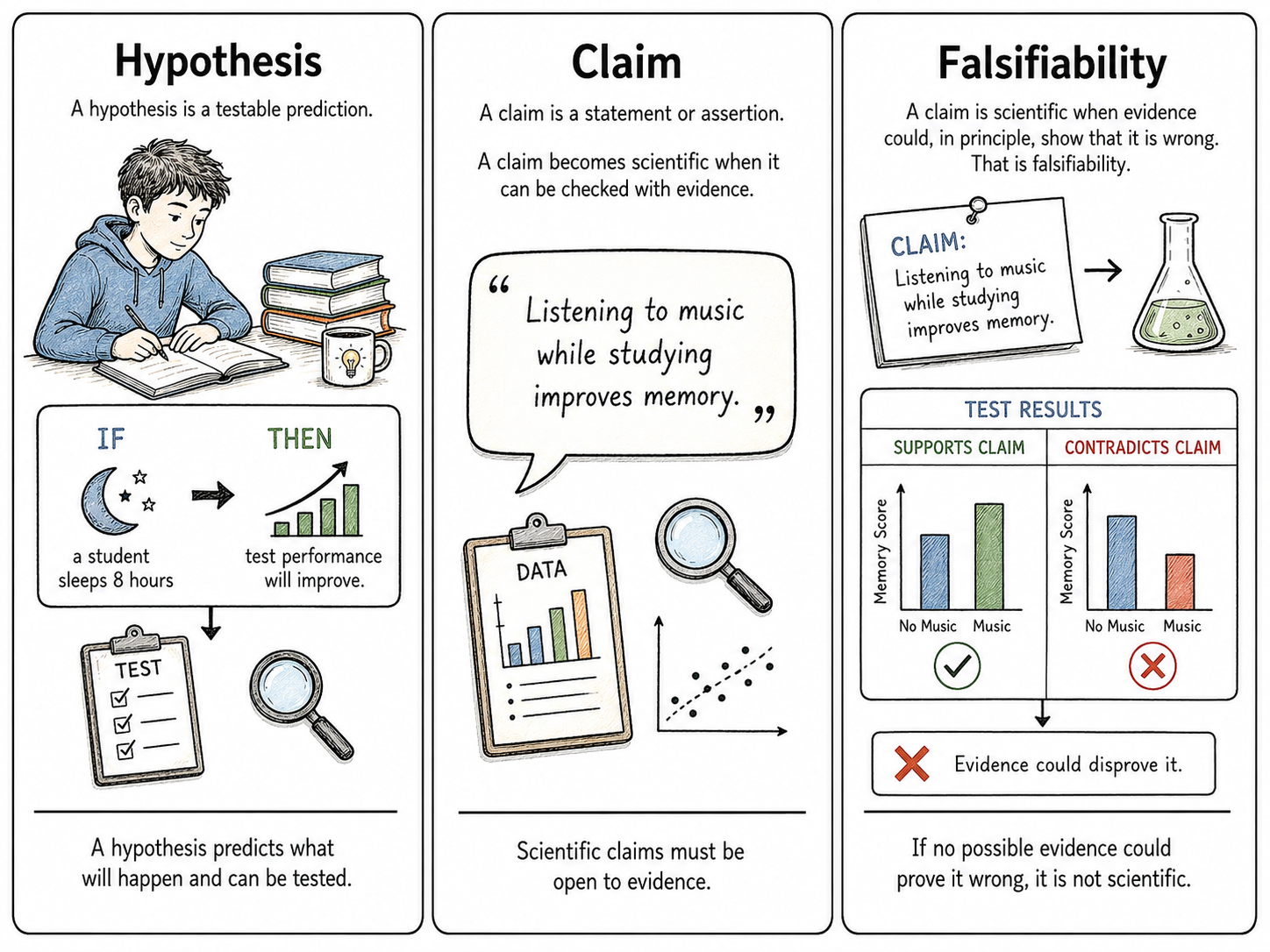
A hypothesis is a testable prediction. A claim is scientific when evidence could, in principle, show that it is wrong. That is falsifiability.
| Statement | Research-Ready? | Why |
|---|---|---|
| Students who sleep 8 hours will recall more words than students who sleep 4 hours. | Yes. | It predicts a measurable difference. |
| Sleep is magical. | No. | It is vague and not scientifically testable. |
| Students who report higher stress will also report lower sleep quality. | Yes. | It predicts a measurable relationship. |
| People act that way because of invisible energy that cannot be measured. | No. | Evidence cannot test or falsify the claim. |
Operational Definitions
An operational definition explains exactly how a variable is measured or manipulated. It turns a broad idea into something observable.
| Abstract Variable | Weak Definition | Operational Definition |
|---|---|---|
| Stress | How stressed someone is. | Score on a 10-item stress questionnaire. |
| Memory | How good memory is. | Number of words recalled from a 20-word list after 5 minutes. |
| Sleep quality | How well someone slept. | Self-rating from 1 to 7 plus total hours slept. |
| Attention | Focus level. | Correct responses on a 5-minute attention task. |
AP move: A good operational definition must be specific enough that another researcher could repeat the measurement.
Variables and Controls
| Term | Meaning | AP Clue |
|---|---|---|
| Variable | Anything that can vary or be measured. | Stress level, study time, recall score. |
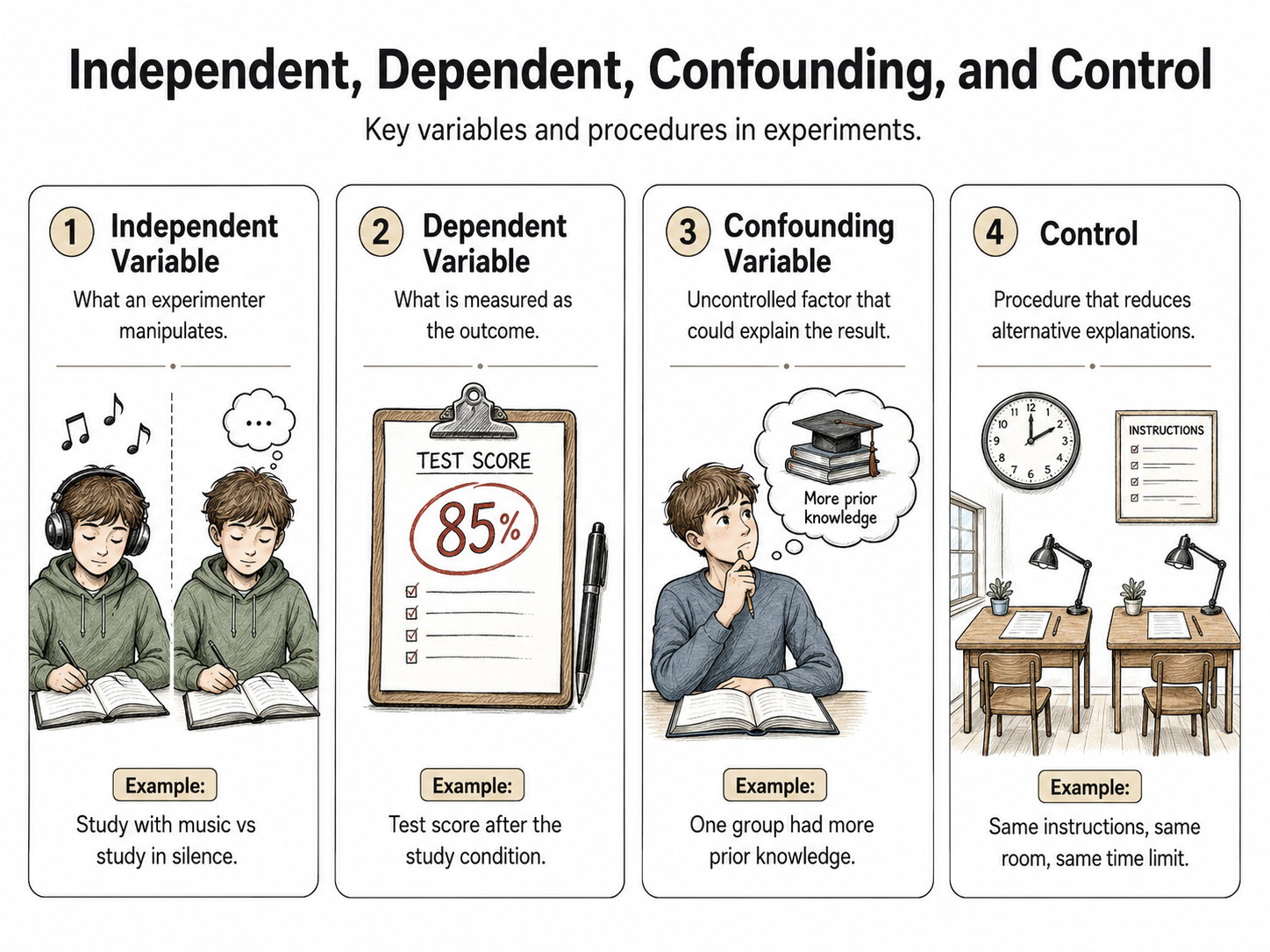
| Independent variable | What an experimenter manipulates. | Study with music vs study in silence. |
| Dependent variable | What is measured as the outcome. | Test score after the study condition. |
| Confounding variable | Uncontrolled factor that could explain the result. | One group had more prior knowledge. |
| Control | Procedure that reduces alternative explanations. | Same instructions, same room, same time limit. |
Reliability and Validity
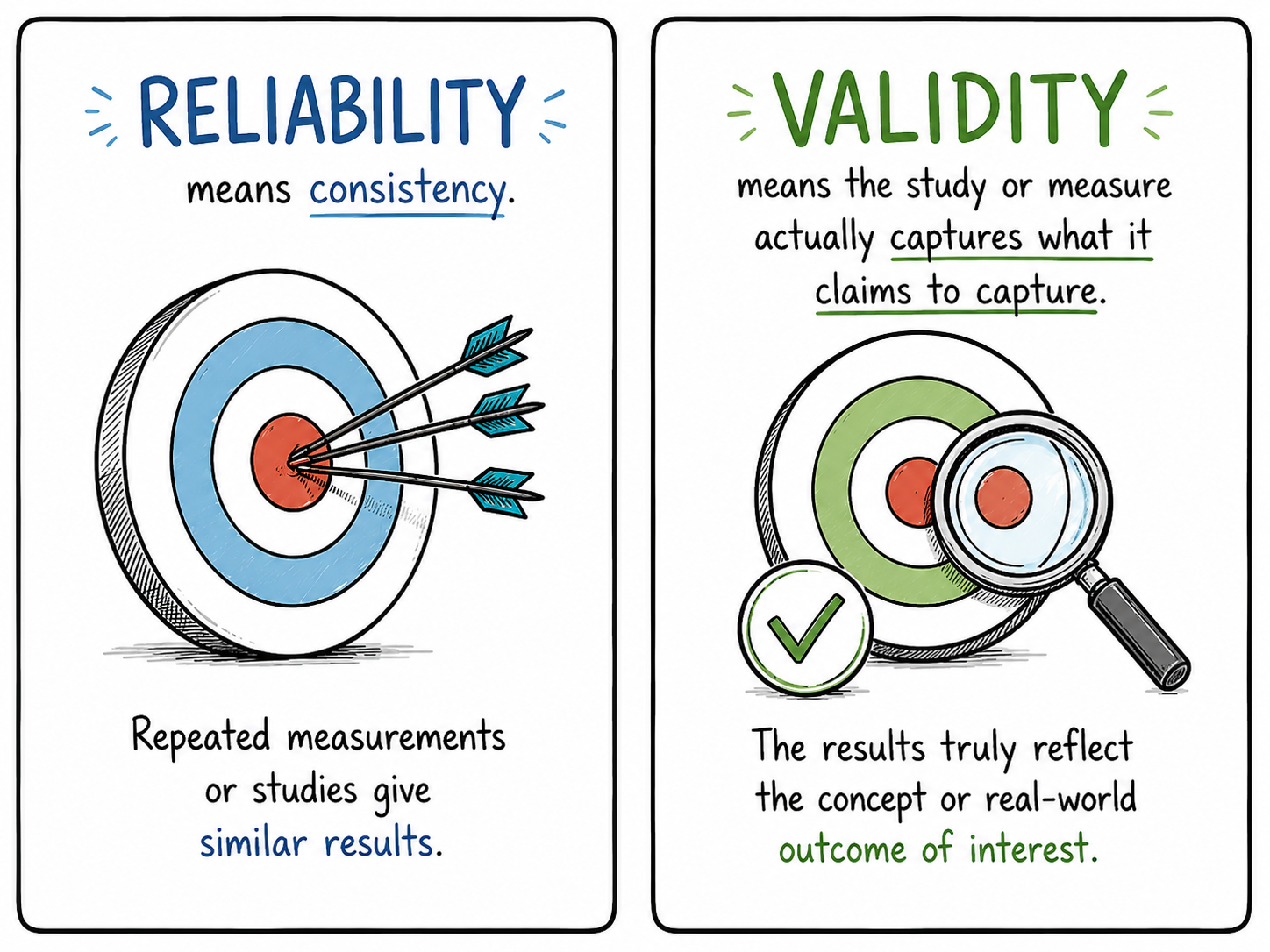
Reliability means consistency. Validity means the study or measure actually captures what it claims to capture.
| Case | Reliable? | Valid? | Why |
|---|---|---|---|
| A scale is always 5 pounds too high. | Yes. | No. | Consistent but inaccurate. |
| A memory test gives similar scores over repeated trials. | Likely yes. | Maybe. | Consistency alone does not prove it measures memory. |
| A "memory" test mostly measures reading speed. | Could be reliable. | No. | The construct is wrong. |
| A study of only one classroom claims to apply to all teenagers. | Not the main issue. | External validity concern. | Generalizability is limited. |
Replication, Peer Review, and Correction
| Process | What It Does | What It Does Not Do |
|---|---|---|
| Replication | Checks whether findings appear again with similar or improved methods. | It does not guarantee identical results every time. |
| Peer review | Lets experts evaluate methods, analysis, and claims before publication. | It does not make a study perfect. |
| Revision | Changes claims based on evidence, criticism, and new data. | It is not failure; it is how science improves. |
| Open methods | Allows others to inspect or repeat a study more easily. | It does not remove every bias automatically. |
Evidence Quality Grid
| Problem | Why It Weakens Evidence | Better Move |
|---|---|---|
| Vague variable. | Others cannot tell what was measured. | Write an operational definition. |
| Small or biased sample. | Generalization is limited. | Use a more representative sample. |
| Confound. | Alternative explanation remains. | Control conditions or random assignment. |
| No replication. | One result may be unstable. | Repeat with similar and varied samples. |
| Overclaiming. | Conclusion exceeds evidence. | Match the claim to the design. |
Vocabulary
- Scientific method: Systematic process for testing claims with evidence.
- Hypothesis: Testable prediction.
- Falsifiability: Ability for evidence to show a claim is wrong.
- Operational definition: Exact way a variable is measured or manipulated.
- Variable: Factor that can vary or be measured.
- Reliability: Consistency of measurement.
- Validity: Accuracy or appropriateness of a measure or conclusion.
- Replication: Repeating a study to check whether results hold.
- Peer review: Expert evaluation before publication.
- Confound: Alternative factor that could explain results.
Common Traps
- Reliable/valid trap: A measure can be consistent but wrong.
- Operational definition trap: A definition must say how the variable is measured or manipulated.
- Replication trap: Replication checks stability; it does not mean copying every detail forever.
- Peer review trap: Peer review improves quality control but does not guarantee truth.
- Overclaim trap: A method supports only the conclusion its design allows.
Quick Check
You are ready when you can turn a broad claim into a testable hypothesis, write an operational definition, and distinguish reliability, validity, replication, and peer review.