Descriptive Research Methods
How do psychologists choose between experimental and non-experimental research, and where do descriptive techniques fit?
The Core Idea
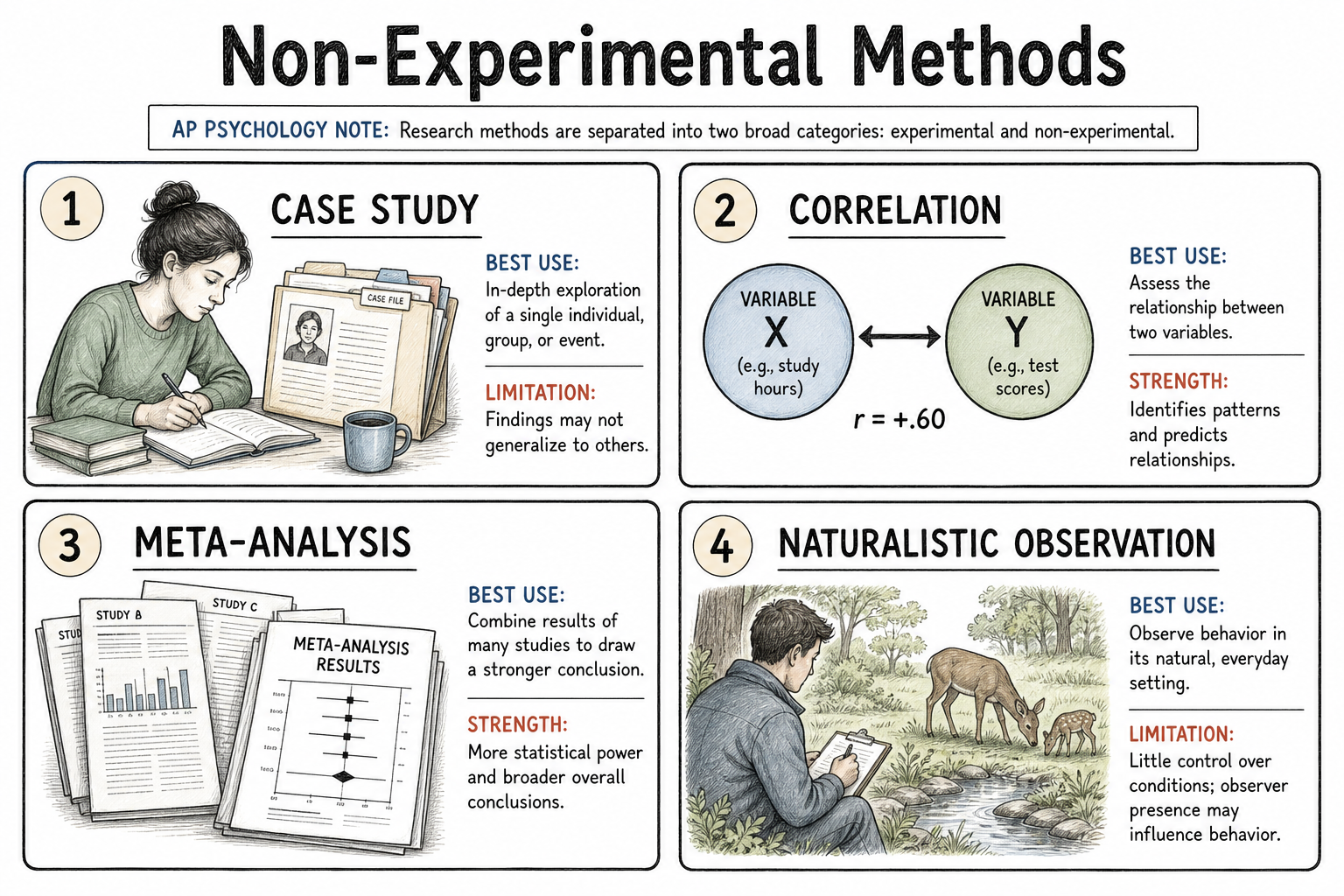
Psychologists choose a research method based on the question they want to answer. AP Psychology separates research into experimental and non-experimental methodologies. Experimental methodology manipulates an independent variable and uses random assignment to groups. The named non-experimental methodologies are case study, correlation, meta-analysis, and naturalistic observation.
Research methods answer different questions. Experiments test causation. Non-experimental methods describe behavior, examine relationships, study unusual cases, or combine previous findings. A survey remains important, but it is a self-report data-collection technique rather than one of the five named methodologies.
Method Comparison
| Method | Best For | Strength | Main Limitation |
|---|---|---|---|
| Experimental methodology | Testing whether changing one variable causes a change in another. | Can support cause-and-effect conclusions when an independent variable is manipulated and participants are randomly assigned. | Some questions cannot be manipulated ethically or practically; artificial settings may not match everyday behavior. |
| Case study | Studying one person, a small group, or an unusual case in depth. | Provides detailed information about rare or complex situations. | Findings may not generalize, and one case cannot establish causation. |
| Correlation | Measuring whether two variables are related and describing the relationship's direction and strength. | Allows prediction and can study variables that cannot be manipulated. | Directionality and third-variable problems mean correlation does not establish causation. |
| Meta-analysis | Combining results from many studies that investigated the same question. | Shows the overall pattern across a larger body of evidence. | Its conclusion is only as strong as the selected studies and their quality. |
| Naturalistic observation | Recording behavior in a real-world setting without manipulating the situation. | Captures behavior in its natural context. | Researchers have less control, observer effects may occur, and causation cannot be established. |
Naturalistic Observation
Naturalistic observation records behavior in a real-world setting without interfering. Its realism is a strength, but realism does not make the method causal. It can collect quantitative counts, qualitative descriptions, or both.
| Good Use | Risk | Protection |
|---|---|---|
| Watching playground cooperation during recess. | Observer bias. | Use clear coding rules and multiple observers. |
| Recording phone use in a cafeteria. | People may change behavior if they notice observation. | Use unobtrusive, ethical observation. |
| Studying behavior in natural context. | Cannot isolate causes. | Do not make causal conclusions. |
Case Studies
A case study investigates one person, small group, or unusual situation in depth. Evidence can come from observation, interviews, records, tests, or several sources. It is especially useful when the case is rare or ethically impossible to create in a lab, and it can generate hypotheses for later research.
| Case Study Can... | Case Study Cannot... |
|---|---|
| Generate hypotheses for later research. | Prove a general rule for everyone. |
| Show detailed changes over time. | Remove all alternative explanations. |
| Teach about rare brain injury, memory disorder, or development. | Guarantee that the case represents the population. |
Meta-Analysis
A meta-analysis statistically combines results from many studies that investigated the same question. It examines the broader pattern across a body of evidence, but the conclusion depends on the quality of the included studies and the rules used to select them.
| AP Recognition Clue | What It Means |
|---|---|
| Combined the results of 32 studies. | Researchers are drawing on many previous studies. |
| Calculated an overall effect across prior research. | Statistical results are being combined. |
| Reviewed a body of studies using statistical analysis. | This is more than a summary of one study. |
Correlation and Experiments
Correlation measures whether two variables are related. It can show direction and strength and support prediction, but directionality and third-variable problems prevent a causal conclusion. Continue to U0.4 for correlation coefficients, scatterplots, and causal traps.
Experimental methodology manipulates an independent variable and uses random assignment to groups. Researchers then measure the dependent variable while trying to control confounding variables. A well-designed experiment can support a cause-and-effect conclusion. Continue to U0.5 for variables, groups, controls, blinding, and validity.
Survey Technique, Self-Report, and Sampling
A survey is a technique for collecting people's reports through questionnaires or interviews. It is tested in AP Psychology, but it is not one of the five named research methodologies. A survey can supply data for a descriptive study or a correlational study, depending on the research question and how the data are analyzed.
| Sampling Term | Meaning | AP Clue |
|---|---|---|
| Population | The full group the researcher wants to understand. | All AP students, all adults, all ninth graders. |
| Sample | The people actually studied. | The 200 students who answered. |
| Representative sample | Sample reflects the population's important characteristics. | Generalization is stronger. |
| Random sample | Every member of the population has an equal chance of selection. | Helps reduce sampling bias. |
| Volunteer bias | People who choose to participate may differ from those who do not. | 10,000 volunteers can still be biased. |
A structured interview asks every participant the same planned questions. A Likert scale asks for an ordered response, such as a level of agreement. Self-report can be inaccurate because of memory, misunderstanding, embarrassment, or deliberate distortion, and a large sample is not automatically representative.
Response and Observer Biases
| Bias | What Happens | Example |
|---|---|---|
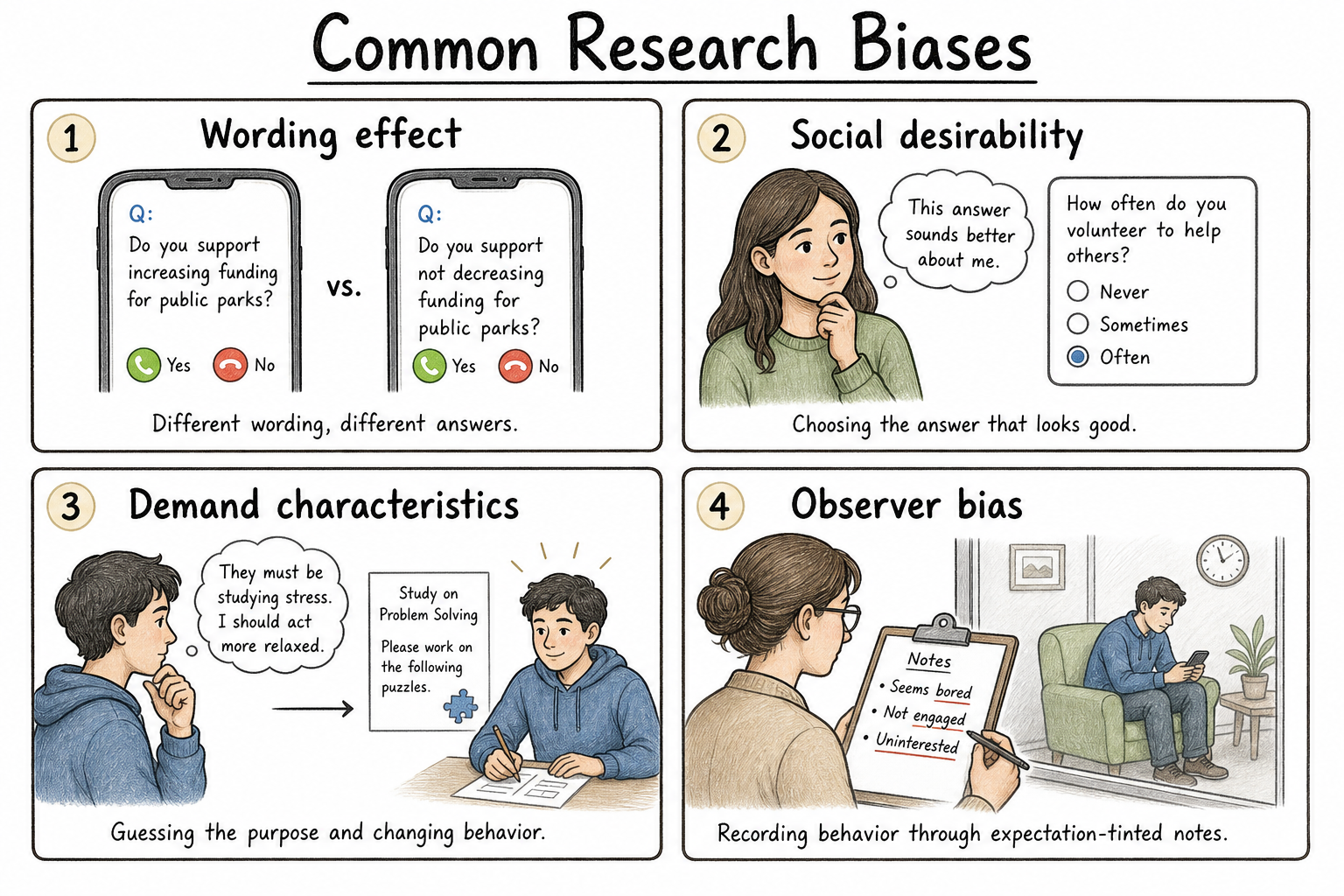
| Wording effect | Question wording changes responses. | "Ban phones" gets different answers than "limit phone distractions." |
| Social desirability bias | Participants answer in a way that looks good. | Underreporting cheating or prejudice. |
| Demand characteristics | Participants change behavior because they guess the study purpose. | Acting more focused after guessing attention is being studied. |
| Observer bias | Researcher expectations influence recording. | Seeing more aggression in a group expected to be aggressive. |
Why Description Is Not Causation
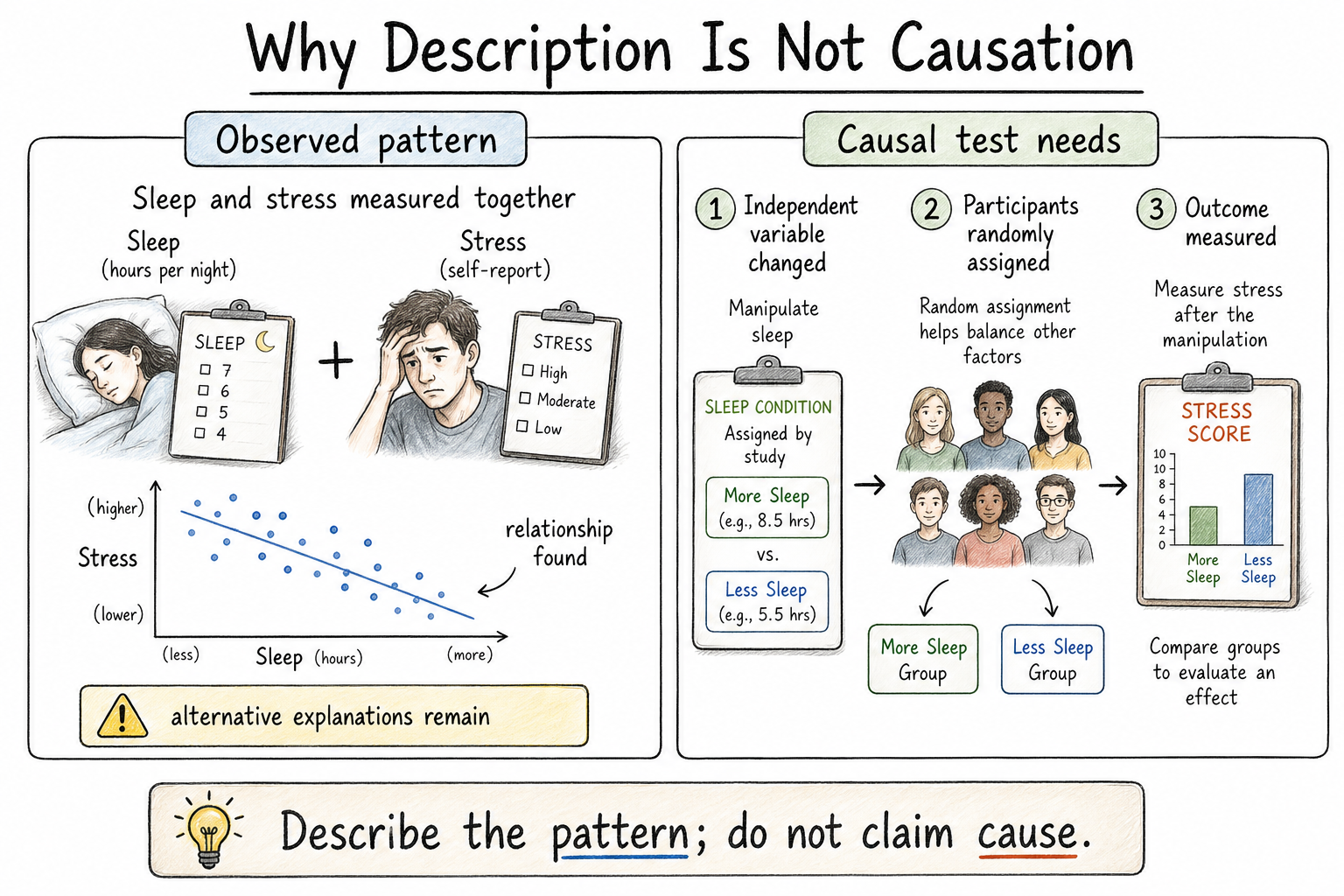
Non-experimental methodologies do not combine a manipulated independent variable with random assignment to conditions. That means alternative explanations remain open, even when a study identifies a strong pattern or relationship.
| Descriptive Finding | Tempting Bad Conclusion | Careful Conclusion |
|---|---|---|
| Students who sleep less report more stress. | Low sleep causes stress. | Low sleep and stress are related in this sample. |
| A case study shows memory problems after injury. | This injury causes the same pattern in everyone. | The case suggests a possible link worth further study. |
| Observed phone use is high during lunch. | Phones cause poor social skills. | Phone use was common in that setting. |
AP Scenario Decoder
Method first, technique second: a survey describes data collection. Ask what researchers did with the responses before deciding whether the broader study was descriptive, correlational, or part of another non-experimental design.
| If the Prompt Mentions... | Identify... | Why |
|---|---|---|
| A manipulated independent variable and random assignment to groups. | Experimental methodology | Both are defining clues for an experiment. |
| Two measured variables described as related, associated, or predictive. | Correlation | The researcher measures a relationship without manipulating variables. |
| Results from many previous studies combined into one overall estimate. | Meta-analysis | The evidence comes from statistically combining a body of research. |
| One person, one small group, or one unusual case studied deeply. | Case study | The goal is depth and detail rather than broad population coverage. |
| Behavior recorded in a natural setting without interference. | Naturalistic observation | The researcher observes behavior in its ordinary context. |
| A questionnaire, Likert scale, or structured interview. | Survey technique; then identify the broader methodology | The survey explains how data were collected, not necessarily the complete research design. |
Vocabulary
- Experimental methodology: Research that manipulates an independent variable and uses random assignment to groups.
- Non-experimental methodology: Research without the combination of manipulated independent variables and random assignment required for an experiment.
- Descriptive research: A useful teaching category for research that describes behavior without manipulating variables.
- Naturalistic observation: Observing behavior in a real setting without interference.
- Case study: In-depth study of one person, group, or situation.
- Correlation: A non-experimental methodology that measures the relationship between variables.
- Meta-analysis: Research that statistically combines results from many studies on the same question.
- Survey: A questionnaire or interview technique used to collect self-report data.
- Structured interview: A survey technique in which participants are asked the same planned questions.
- Likert scale: An ordered response scale commonly used to measure attitudes or ratings.
- Self-report bias: Inaccuracy or distortion in information participants report about themselves.
- Social desirability bias: The tendency to answer in a way that appears acceptable or favorable.
- Directionality problem: Uncertainty about which correlated variable may influence the other.
- Third-variable problem: The possibility that another variable explains an observed correlation.
- Population: Full group of interest.
- Sample: Participants actually studied.
- Representative sample: Sample that reflects the population.
- Random sample: Selection method where each population member has equal chance.
- Wording effect: Question phrasing changes responses.
- Demand characteristics: Participants change behavior after guessing study purpose.
- Observer bias: Researcher expectations affect observation.
Common Traps
- Five-method trap: Survey is tested, but it is not one of the five methodologies named in the current CED.
- Survey-label trap: A study can collect survey responses and still be correlational if it measures the relationship between two variables.
- Meta-analysis trap: Meta-analysis does not mean a study that merely uses statistics; it combines results from multiple studies.
- Experiment trap: A comparison between groups is not automatically an experiment. Look for a manipulated independent variable and random assignment.
- Correlation trap: A strong correlation is not evidence of causation; directionality and third variables remain possible.
- Case-study trap: Detailed evidence from one unusual person does not automatically apply to everyone.
- Observation trap: Natural behavior can be realistic while still being affected by observer bias, reactivity, or uncontrolled variables.
- Sampling trap: Random sampling helps represent a population; random assignment creates comparable experimental groups. They solve different problems.
Quick Check
You are ready when you can identify the five methodologies, distinguish survey technique from a broader methodology, and explain why non-experimental evidence cannot establish causation.