Experimental Psychology
How do psychologists design studies that can support cause-and-effect conclusions?
The Core Idea
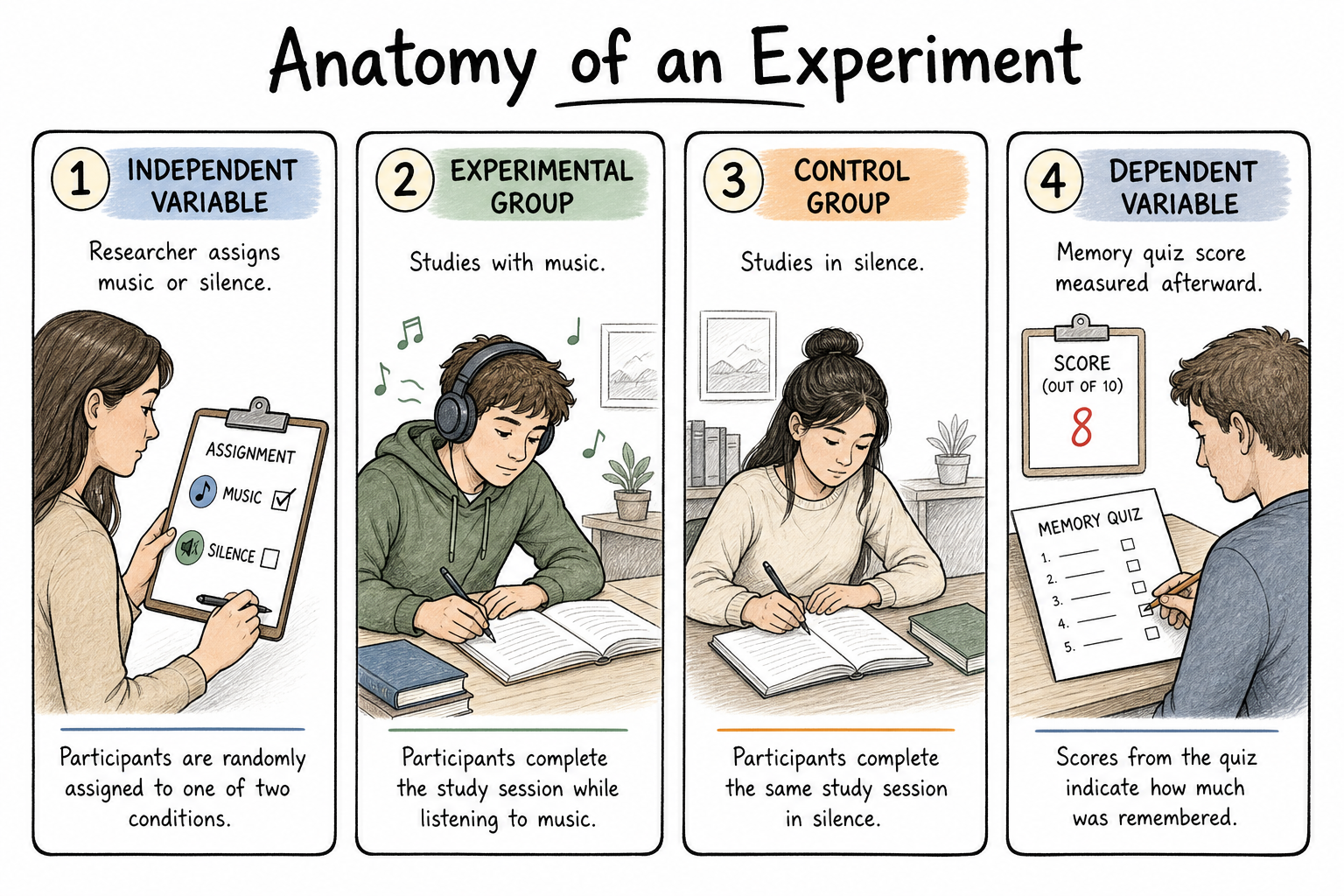
An experiment tests cause and effect by manipulating an independent variable and measuring its effect on a dependent variable. The goal is to make groups comparable except for the treatment or condition being tested.
The exam usually asks whether a design can make a causal claim, which variable is which, or how a procedure controls bias and confounds.
Core Experiment Terms
| Term | Meaning | AP Clue |
|---|---|---|
| Independent variable | Variable the researcher manipulates. | Assigned to music vs silence. |
| Dependent variable | Outcome the researcher measures. | Memory score after studying. |
| Experimental group | Receives the treatment or key condition. | Gets caffeine, therapy, reward, or intervention. |
| Control group | Comparison group that does not receive the active treatment. | Gets no treatment, normal condition, or placebo. |
| Confounding variable | Uncontrolled factor that could explain results. | One group had more sleep before the test. |
Groups and Conditions
Experiments compare conditions. The question is whether the independent variable is the only systematic difference between groups.
| Design Piece | Purpose | Example |
|---|---|---|
| Treatment condition | Tests the active manipulation. | Students study with music. |
| Control condition | Provides baseline comparison. | Students study in silence. |
| Same procedure | Reduces confounds. | Both groups use the same word list and time limit. |
| Outcome measurement | Shows the dependent variable. | Number of words recalled. |
Random Assignment vs Random Sampling
This is one of the highest-value close calls in Unit 0.
| Procedure | Question It Answers | Protects | AP Clue |
|---|---|---|---|
| Random assignment | Who goes into which condition? | Internal validity and causal inference. | Participants have equal chance of being in treatment or control. |
| Random sampling | Who is selected from the population? | Generalizability. | Every population member has equal chance of being chosen. |
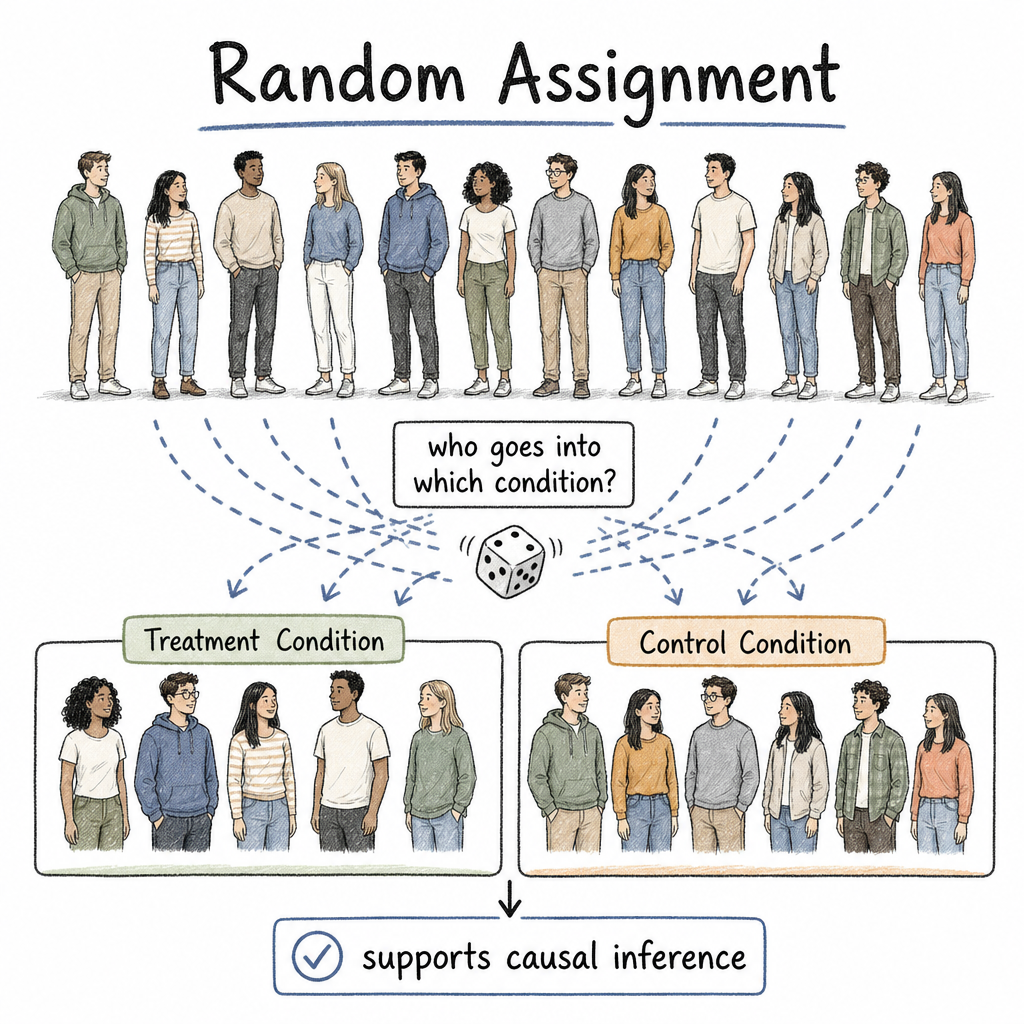
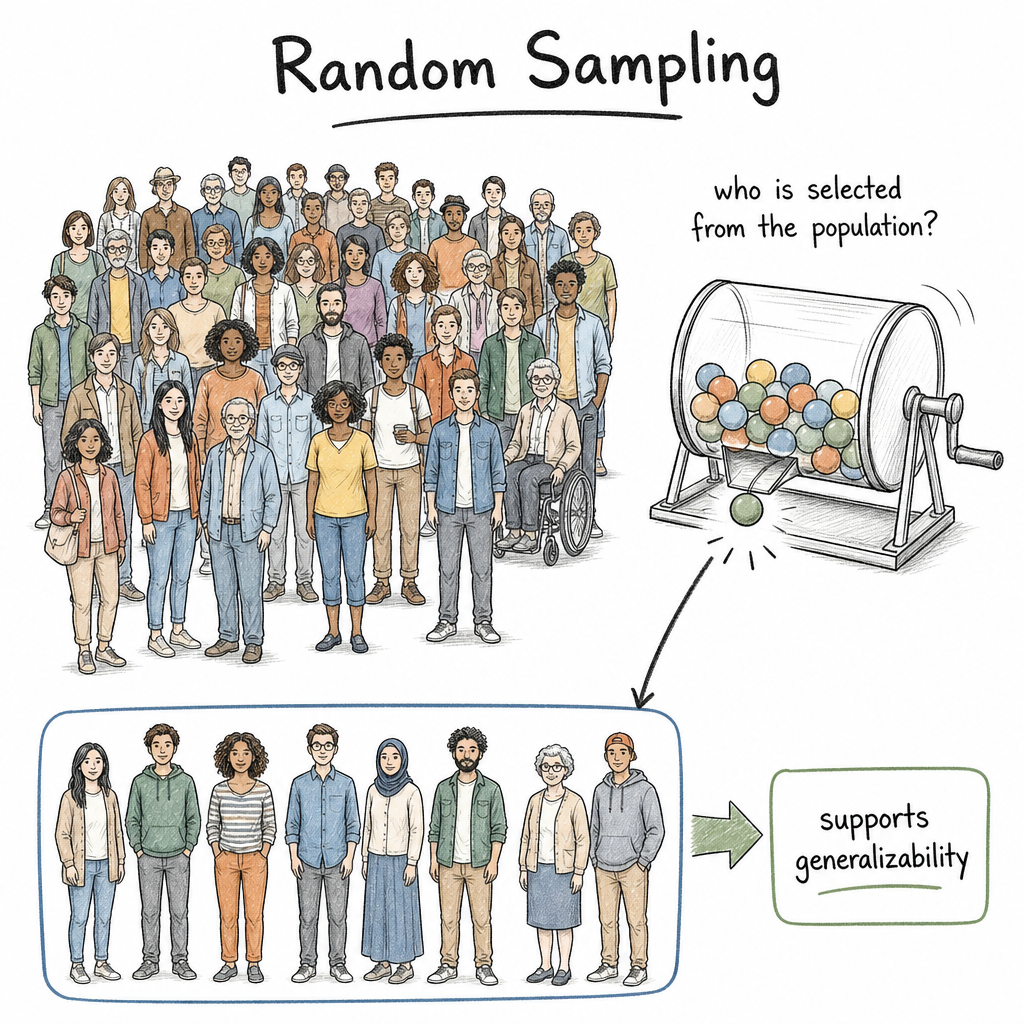
Memory move: Assignment is for conditions. Sampling is for selection.
Placebo and Blinding
| Procedure | What It Controls | Example |
|---|---|---|
| Placebo | Expectation effects. | Inactive pill that participants believe may be treatment. |
| Single-blind study | Participant expectations. | Participants do not know their condition. |
| Double-blind study | Participant and researcher expectations. | Neither participants nor data collectors know who got treatment. |
| Standardized instructions | Unequal treatment by researchers. | Every group hears the same script. |
Confounds and Internal Validity
Internal validity asks whether the study supports the conclusion that the independent variable caused the change in the dependent variable.
| Confound | Why It Is a Problem | Fix |
|---|---|---|
| One group tests in the morning and one at night. | Time of day may affect performance. | Balance or standardize testing time. |
| One teacher encourages one group more. | Researcher behavior may affect outcome. | Standardized script or blinding. |
| High-achieving students are placed mostly in one group. | Preexisting ability may explain results. | Random assignment. |
| Different materials are used across groups. | Material difficulty may explain results. | Use equivalent materials. |
Causation Claim Check
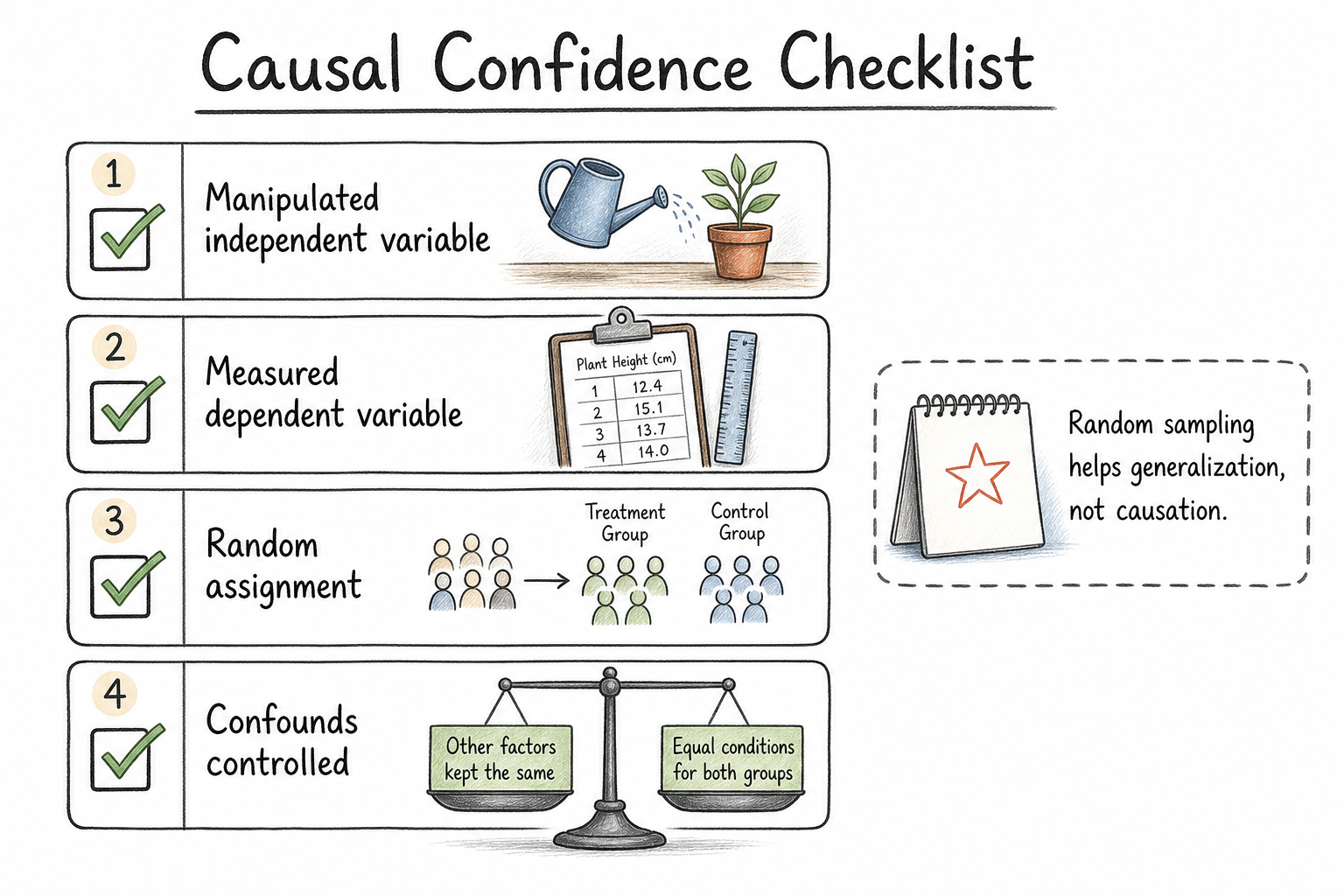
A causal conclusion is strongest when the researcher manipulates the independent variable, randomly assigns participants, controls confounds, and measures the dependent variable consistently.
| Design Feature | Needed for Causal Confidence? | Why |
|---|---|---|
| Manipulated IV | Yes. | The researcher creates the difference between conditions. |
| Measured DV | Yes. | Shows the outcome being affected. |
| Random assignment | Strongly important. | Balances preexisting differences. |
| Control group | Usually important. | Provides comparison baseline. |
| Random sampling | Not required for causation. | It helps generalization, not cause within the study. |
AP Scenario Decoder
| If the Prompt Mentions... | Think... | Why |
|---|---|---|
| Researcher assigns participants to treatment or control. | Random assignment. | Condition placement is being controlled. |
| Inactive pill or fake treatment. | Placebo. | Expectation effect comparison. |
| Neither participant nor researcher knows condition. | Double blind. | Reduces both participant and researcher bias. |
| Outcome after manipulation. | Dependent variable. | The result is measured. |
| Alternative explanation for group difference. | Confound. | Threatens causal interpretation. |
| Cause-and-effect conclusion. | Experiment. | Requires manipulation and control. |
Vocabulary
- Experiment: Research design that manipulates a variable to test cause and effect.
- Independent variable: Manipulated variable.
- Dependent variable: Measured outcome.
- Experimental group: Group receiving the treatment or key condition.
- Control group: Comparison group.
- Random assignment: Random placement into conditions.
- Random sampling: Random selection from a population.
- Placebo: Inactive treatment used for comparison.
- Single blind: Participants do not know condition.
- Double blind: Participants and researchers do not know condition.
- Confound: Alternative factor that threatens causal interpretation.
- Internal validity: How well a study supports its causal conclusion.
Common Traps
- IV/DV trap: IV is manipulated; DV is measured.
- Assignment/sampling trap: Assignment supports causation; sampling supports generalization.
- Placebo trap: Placebo controls expectation effects, not every confound.
- Blind trap: Double blind reduces both participant and researcher expectation effects.
- Causation trap: A study needs manipulation and control to support cause and effect.
Quick Check
You are ready when you can label IV, DV, groups, assignment, placebo/blind procedures, confounds, and explain when an experiment supports causation.