Ethical Guidelines in Psychological Research
How do psychologists protect participants while still collecting useful evidence?
The Core Idea
Research ethics protects people and animals from unnecessary harm while allowing researchers to learn about behavior and mental processes.
The AP move is always specific: identify the ethical rule, connect it to the procedure, and explain the protection or problem.
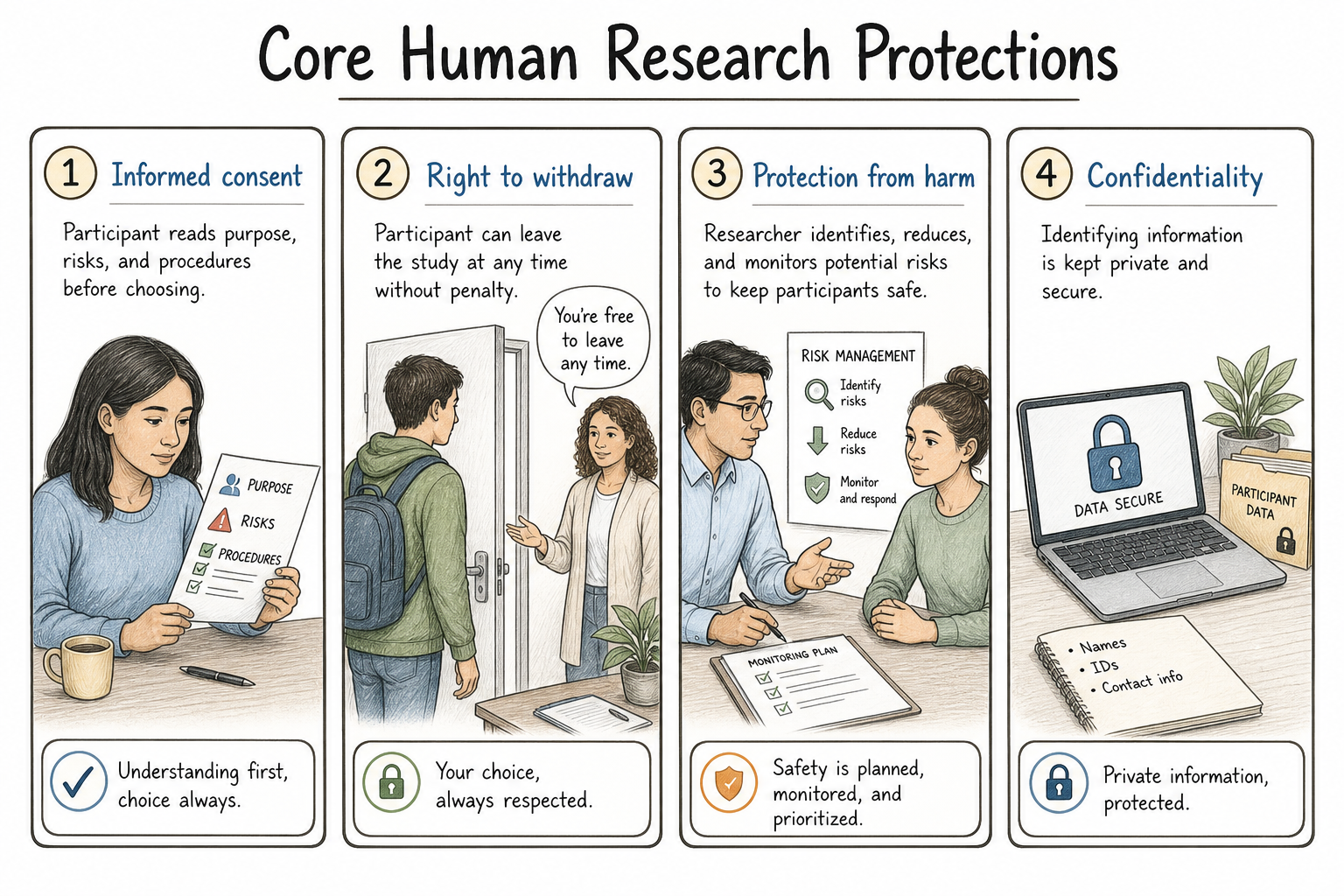
Human Participant Protections
| Guideline | What It Requires | AP Clue |
|---|---|---|
| Informed consent | Participants get enough information to decide whether to participate. | Purpose, risks, procedures, voluntary participation. |
| Right to withdraw | Participants can leave without penalty. | Can stop at any time. |
| Protection from harm | Risk must be minimized and justified. | Distress, injury, embarrassment, lasting harm. |
| Confidentiality | Private data is protected. | Names removed, secure records, anonymous reporting. |
| Debriefing | Participants are informed afterward, especially after deception. | Explains true purpose and resolves distress. |
Deception and Debriefing
Deception can be allowed only when it is justified, does not create unreasonable risk, and is followed by debriefing.
| Procedure | Ethical Question | Strong Answer |
|---|---|---|
| Participants are told the study is about memory, but it is about conformity. | Is deception justified and debriefed? | Explain that deception requires later debriefing about the true purpose. |
| Participants are frightened without warning. | Was risk minimized? | Discuss protection from harm and right to withdraw. |
| Researchers hide identity in published data. | Was privacy protected? | Discuss confidentiality or anonymity. |
IRB and Risk-Benefit Review
An Institutional Review Board, or IRB, reviews research before it begins. It considers risks, benefits, consent, privacy, vulnerable participants, and whether the procedures are justified.
| IRB Checks... | Why It Matters |
|---|---|
| Are risks reasonable compared with possible benefits? | Participants should not face unnecessary harm. |
| Is consent clear? | Participants need meaningful choice. |
| Is deception necessary? | Researchers should not deceive without justification. |
| Are vulnerable participants protected? | Children, prisoners, or dependent groups need extra care. |
| Is private data secured? | Confidentiality protects participants after data collection. |
Vulnerable Participants
Some participants need extra safeguards because they may have less power, understanding, or freedom to refuse.
| Group or Situation | Extra Concern | Possible Protection |
|---|---|---|
| Children | Limited ability to give full consent. | Parental consent and child assent. |
| Students in a teacher's class | May feel pressured to participate. | Clear voluntary choice and no penalty for refusal. |
| People experiencing distress | Greater risk of harm. | Minimize risk and provide support resources. |
| Private or sensitive topics | Confidentiality risk. | Secure data and remove identifying information. |
Animal Research Care
Animal research must follow legal and ethical standards for humane care, minimized suffering, appropriate housing, and justified scientific purpose.
| Principle | Meaning | AP Wording |
|---|---|---|
| Humane care | Animals receive proper housing, feeding, and veterinary care. | Basic welfare must be protected. |
| Minimize pain | Procedures should reduce discomfort when possible. | Suffering must be limited and justified. |
| Scientific justification | Study should answer a meaningful question. | Research benefit must matter. |
| Oversight | Review boards or committees evaluate animal procedures. | Researchers do not decide alone. |
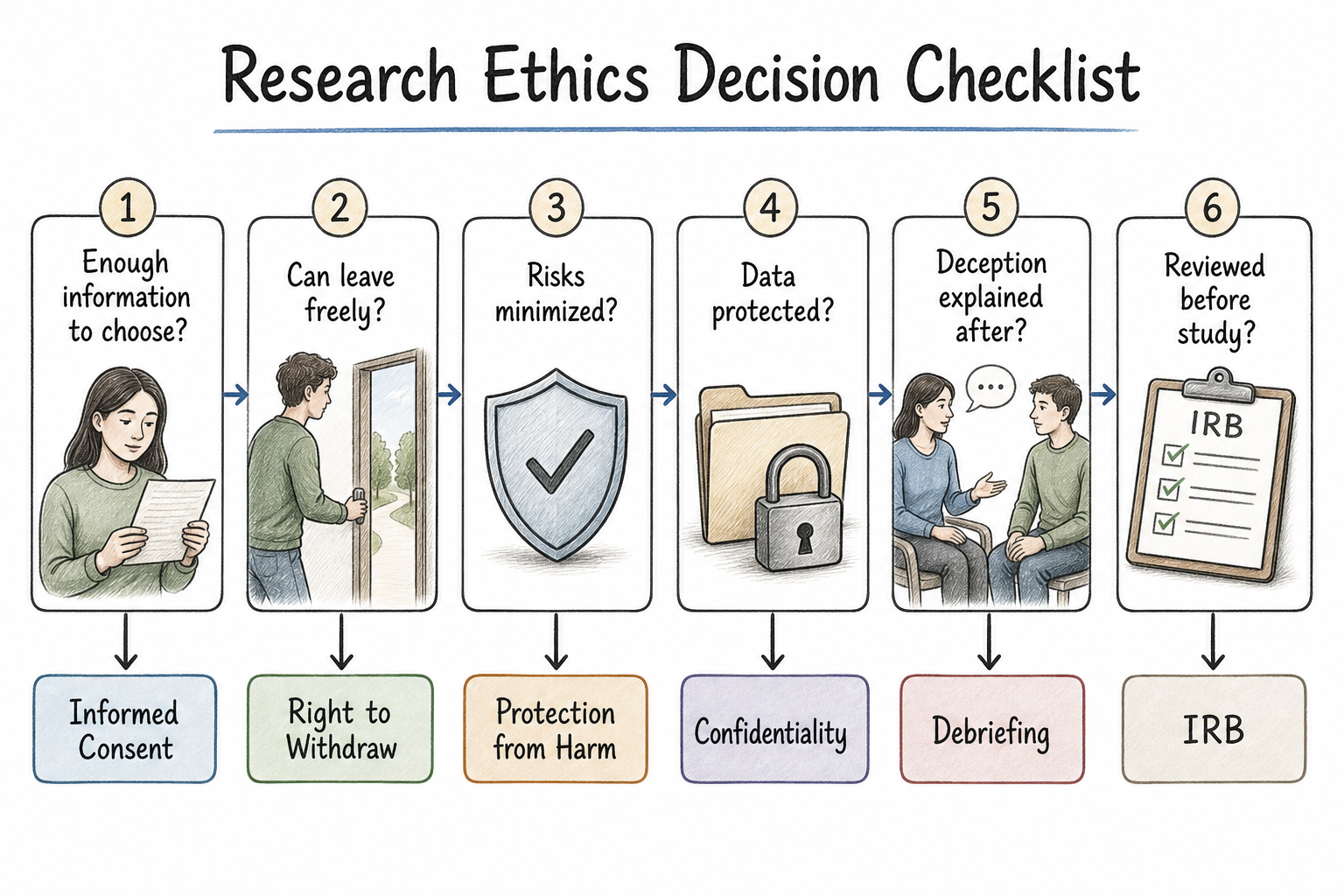
Ethics Decision Checklist
| Ask... | If No... | Likely Guideline |
|---|---|---|
| Did participants know enough to choose? | Consent problem. | Informed consent. |
| Could participants leave freely? | Coercion problem. | Right to withdraw. |
| Were risks minimized? | Harm problem. | Protection from harm. |
| Was private data protected? | Privacy problem. | Confidentiality. |
| Was deception explained afterward? | Post-study problem. | Debriefing. |
| Was the study reviewed before it began? | Oversight problem. | IRB or ethics review. |
AP Scenario Decoder
| If the Prompt Mentions... | Think... | Answer Move |
|---|---|---|
| Participants were not told risks. | Informed consent. | Explain what information was missing. |
| Participants could not stop. | Right to withdraw. | Explain why voluntary participation was violated. |
| Names attached to sensitive answers. | Confidentiality. | Explain data privacy risk. |
| Participants were misled. | Deception and debriefing. | Explain whether debriefing is required. |
| Study uses children. | Vulnerable participants. | Explain extra consent and protection needs. |
| Animal discomfort. | Humane care and justification. | Explain minimized harm and oversight. |
Vocabulary
- Informed consent: Participants receive enough information to decide whether to participate.
- Right to withdraw: Participants may leave without penalty.
- Protection from harm: Researchers minimize physical and psychological risk.
- Confidentiality: Private participant data is protected.
- Deception: Misleading participants about some study detail when justified.
- Debriefing: Explaining the study afterward, especially after deception.
- IRB: Review board that evaluates ethical issues before research begins.
- Risk-benefit analysis: Comparing possible harm with scientific value.
- Vulnerable participants: Groups needing extra protection.
- Humane animal care: Ethical treatment and minimized suffering in animal research.
Common Traps
- Vague ethics trap: "It was unethical" is too weak without naming a guideline.
- Consent trap: Consent requires meaningful information and voluntary choice.
- Deception trap: Deception is not automatically banned, but it must be justified and debriefed.
- Privacy trap: Confidentiality protects data; anonymity means identity is not collected or linked.
- Animal trap: Animal research still requires oversight and humane care.
Quick Check
You are ready when you can name the exact ethical guideline in a scenario and explain how the study protects or fails to protect participants or animals.