Research Skills in Psychology: AAQ and EBQ
How do students analyze a study, build an evidence-based argument, and explain limitations without overclaiming?
The Core Idea
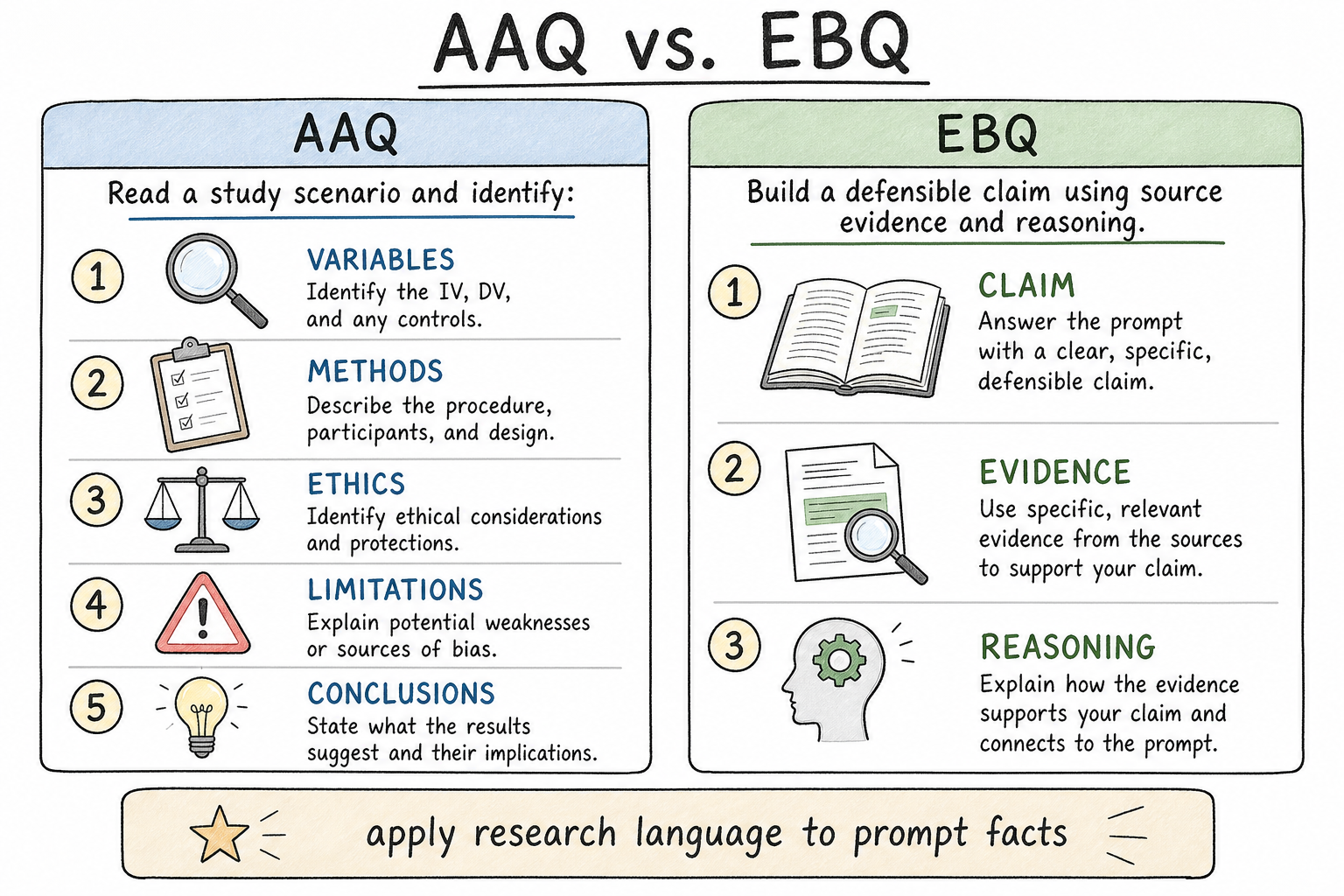
Research-skill questions ask you to use methods vocabulary in context. A strong response does not simply define a term; it applies the term to the study or evidence in the prompt.
Think of Unit 0 as your toolkit for every later evidence question: identify the design, name variables, judge ethics, evaluate limitations, and connect evidence to a claim.
AAQ vs EBQ
| Question Type | Main Task | Strong Response Does... |
|---|---|---|
| AAQ | Analyze a research scenario or study. | Identifies variables, methods, ethics, limitations, and conclusions in context. |
| EBQ | Build or evaluate an argument using evidence. | Makes a defensible claim, uses evidence, and explains reasoning. |
| Both | Use precise research language. | Connects terms to facts from the prompt instead of reciting definitions. |
Claim, Evidence, Reasoning
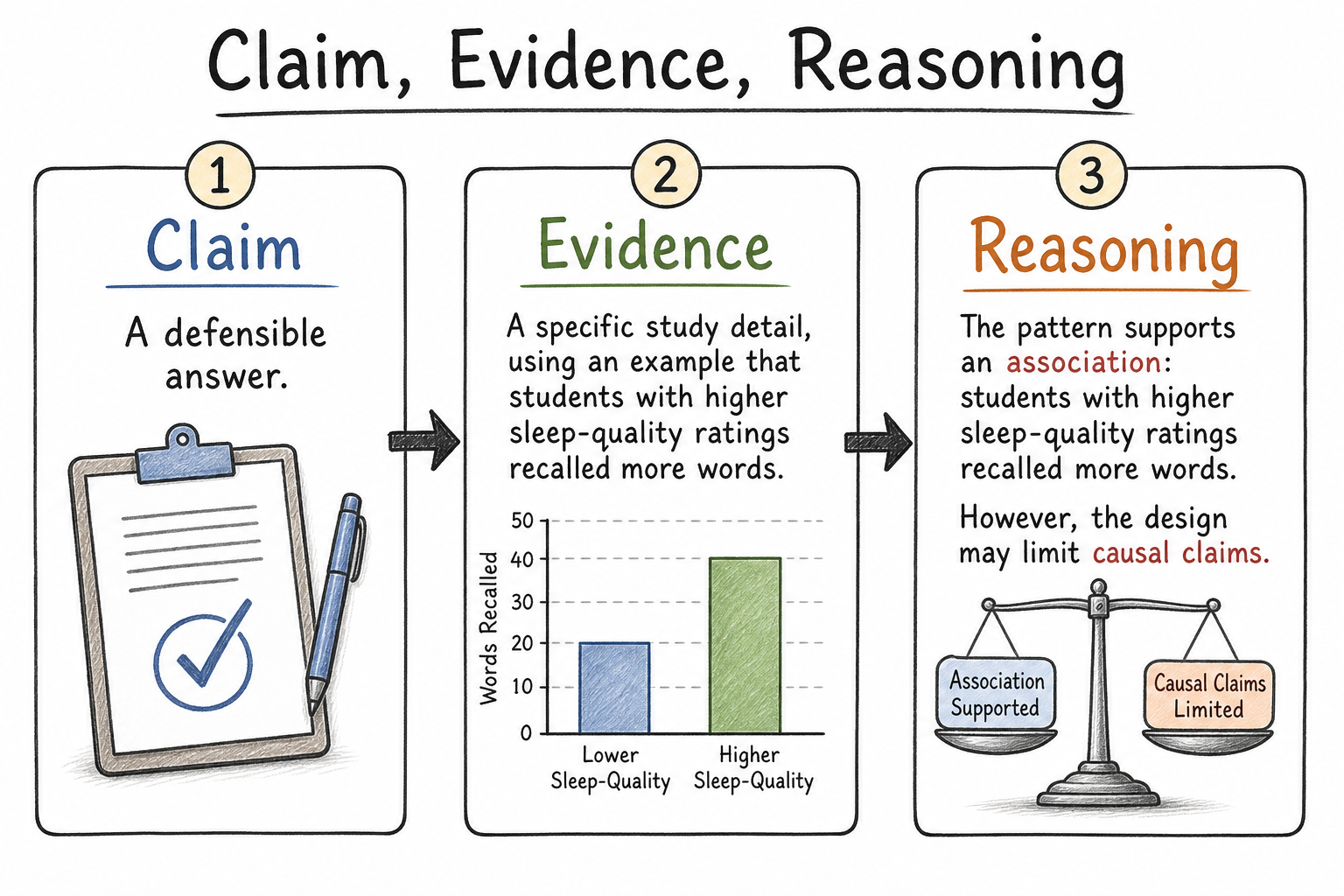
EBQ success depends on clear claim-evidence-reasoning structure.
| Part | Meaning | Weak Version | Stronger Version |
|---|---|---|---|
| Claim | Defensible answer to the question. | Sleep matters. | Better sleep quality is likely related to stronger memory performance. |
| Evidence | Specific source detail. | The study says so. | Students with higher sleep-quality ratings recalled more words. |
| Reasoning | Explains why evidence supports the claim. | This proves it. | The pattern supports an association between sleep quality and memory, although the design limits causal claims. |
Operationalizing Variables
When a prompt asks for an operational definition, write the exact measurement or manipulation. Do not just restate the concept.
| Task | Too Vague | AAQ/EBQ-Ready |
|---|---|---|
| Operationalize anxiety. | How anxious students are. | Score on a 10-item anxiety questionnaire completed before the test. |
| Operationalize memory. | Memory ability. | Number of correct words recalled from a 20-word list after 5 minutes. |
| Operationalize phone use. | How much they use phones. | Minutes of screen time recorded during a 30-minute study period. |
| Operationalize achievement. | How well they did. | Percentage correct on a 40-question unit exam. |
Identifying Limitations
A limitation narrows what the conclusion can say. It does not automatically make the study useless.
| Limitation | How It Narrows the Claim | Better Than Saying... |
|---|---|---|
| Small sample. | Results may be unstable or need replication. | The study proves nothing. |
| Unrepresentative sample. | Generalization to the target population is limited. | The data are fake. |
| No random assignment. | Causal claims are weakened. | The relationship is meaningless. |
| Self-report measure. | Responses may be biased by memory or social desirability. | Participants always lie. |
| Artificial setting. | Ecological validity may be limited. | The study cannot teach anything. |
Generalizability and Validity
| Concern | Question to Ask | Prompt Clue |
|---|---|---|
| Generalizability | Can the finding apply beyond the sample? | Sample is all from one school, age, region, or volunteer pool. |
| Ecological validity | Does the setting resemble real life? | Artificial lab task or unrealistic procedure. |
| Construct validity | Does the measure capture the intended concept? | A "memory" test mostly measures reading speed. |
| Internal validity | Can the study support a causal conclusion? | Confounds or lack of random assignment. |
Ethical Analysis in Writing
Ethics responses should follow the same pattern: name the rule, point to the study detail, explain the protection or violation.
| Prompt Detail | Ethics Term | Strong Explanation |
|---|---|---|
| Participants were told they could stop at any time. | Right to withdraw. | This protects voluntary participation because participants are not trapped in the study. |
| Names were removed from data. | Confidentiality. | This protects privacy by reducing the chance answers can be linked to individuals. |
| Participants were misled and then told the true purpose afterward. | Deception and debriefing. | Debriefing helps correct the deception and explain the study. |
| Students were required by their teacher to participate. | Coercion / consent concern. | The power relationship may make participation feel involuntary. |
Writing Frames
| Task | Frame |
|---|---|
| Identify a variable. | The independent variable is ___ because the researcher manipulated ___. |
| Explain a limitation. | This limits ___ because ___, so the conclusion should be narrowed to ___. |
| Use evidence. | The evidence shows ___, which supports the claim because ___. |
| Discuss ethics. | The relevant ethical guideline is ___ because the study procedure ___. |
| Block causation. | The study can show ___, but it cannot prove causation because ___. |
AP Scenario Decoder
| If the Prompt Asks... | Do This | Do Not Do This |
|---|---|---|
| Identify an operational definition. | Name the exact measure or manipulation. | Define the concept vaguely. |
| Explain generalizability. | Discuss sample and target population. | Say "it applies to everyone." |
| Evaluate causation. | Check manipulation, random assignment, and confounds. | Assume any relationship is causal. |
| Use evidence in EBQ. | Quote or paraphrase source detail and explain why it matters. | Drop evidence without reasoning. |
| Discuss ethics. | Name the guideline and connect it to a procedure. | Say only "ethical" or "unethical." |
Vocabulary
- AAQ: Article analysis question focused on interpreting research.
- EBQ: Evidence-based question focused on argument using sources.
- Claim: Defensible answer to a question.
- Evidence: Specific source or study detail.
- Reasoning: Explanation of why evidence supports a claim.
- Operationalize: Define how a variable is measured or manipulated.
- Limitation: Feature that narrows what a conclusion can say.
- Generalizability: Whether findings can apply beyond the sample.
- Construct validity: Whether a measure captures the intended concept.
- Ecological validity: Whether the setting or task resembles real life.
Common Traps
- Evidence dump trap: Evidence needs reasoning.
- Definition trap: Applying a term is stronger than merely defining it.
- Limitation trap: A limitation narrows a conclusion; it does not erase all value.
- Generalization trap: Sample details decide who the result can reasonably apply to.
- Ethics trap: Name the specific guideline, not just "good" or "bad."
Quick Check
You are ready when you can write a claim, use evidence with reasoning, operationalize variables, explain a limitation, judge generalizability, and analyze ethics in context.