Interaction of Heredity and Environment
How do inherited tendencies and lived environments work together instead of competing as simple opposites?
The Core Idea
Heredity refers to inherited biological tendencies. Environment refers to the conditions and experiences that shape development and behavior.
The best AP answer is usually not "nature" or "nurture." It is the interaction: a person may inherit a tendency, but stress, culture, nutrition, parenting, schooling, peers, sleep, trauma, practice, and opportunity influence how that tendency appears.
Use careful wording: genes influence likelihoods; they do not write a guaranteed script for one individual.
Nature, Nurture, and Interaction
These terms are easy to memorize but easy to misuse. The exam often gives a scenario where both biology and context matter.
| Term | Meaning | AP Clue | Write It Like This |
|---|---|---|---|
| Heredity / nature | Inherited predispositions and biological influence. | Genes, biological relatives, inherited tendency. | The person may have a genetic predisposition. |
| Environment / nurture | External conditions and experiences. | Family, school, stress, culture, practice, nutrition. | The environment can increase, reduce, or redirect the expression of that tendency. |
| Interaction | Heredity and environment shaping each other in one outcome. | A predisposition changes under different conditions. | The outcome reflects both inherited risk and lived context. |
Exam move: Name the inherited tendency, name the environmental condition, then explain how the condition changes expression.
Predisposition Is Not Destiny
A genetic predisposition means increased likelihood, not certainty. Environments can trigger, buffer, strengthen, or weaken expression.
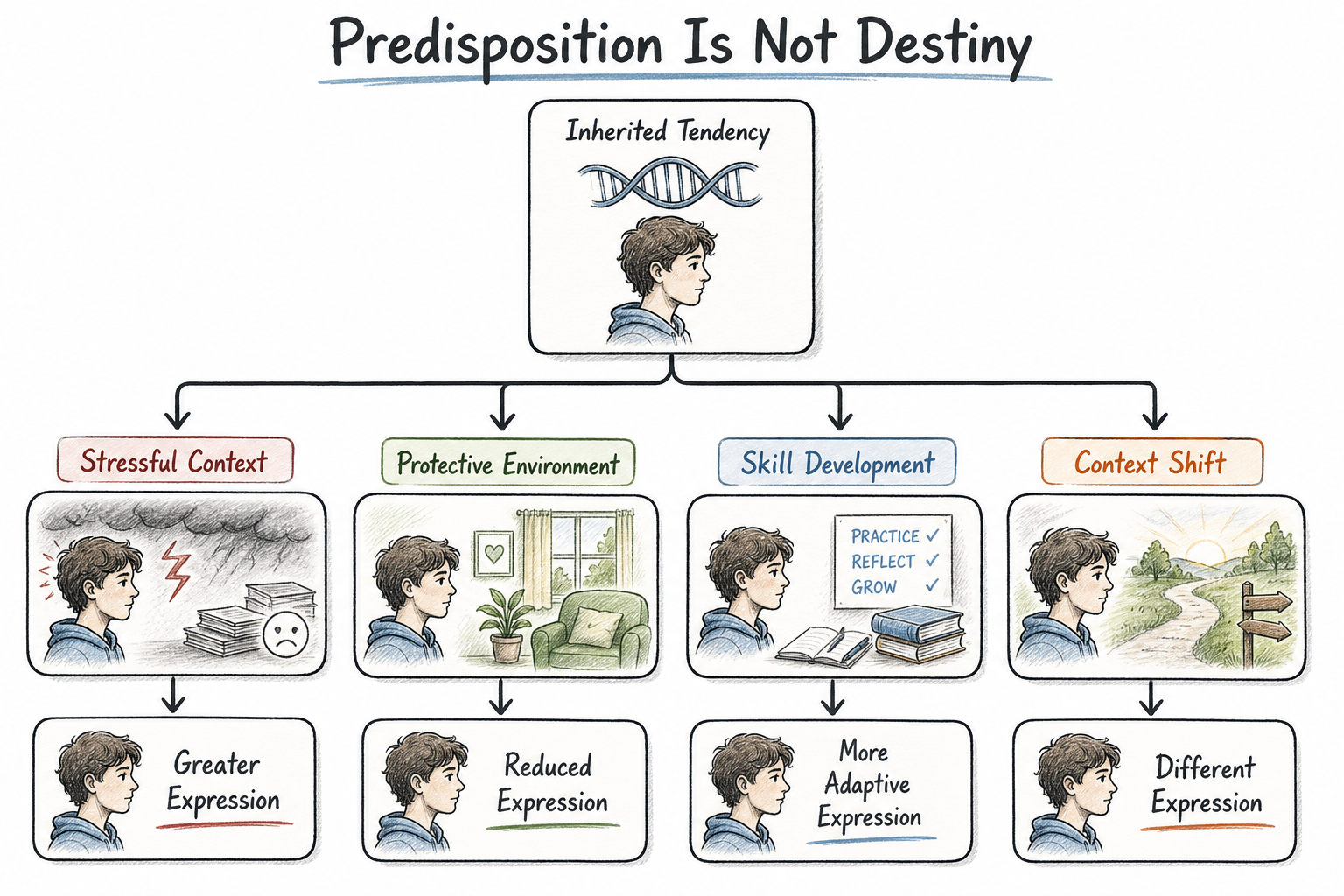
| Pattern | What It Means | Student-Friendly Example |
|---|---|---|
| Risk expression | A tendency appears more strongly in a stressful or unsupportive context. | A child with a reactive temperament struggles more when sleep and support are poor. |
| Protective environment | Support reduces the impact of inherited risk. | Consistent routines and coping skills reduce anxiety vulnerability. |
| Skill development | Practice changes what a predisposition can become. | Good coordination matters more when training is available. |
| Context shift | The same tendency can help in one setting and hurt in another. | High sensitivity can mean distraction in one room and careful observation in another. |
Evolutionary Perspective
The evolutionary perspective asks how a trait or behavior may have helped survival or reproduction across generations. Natural selection is the process through which traits linked to survival or reproductive success become more common in a population.
| Good Evolutionary Claim | Weak or Harmful Claim | Why It Matters |
|---|---|---|
| A fear response may have helped ancestors avoid danger. | Everyone is genetically destined to fear the same things. | Preparedness is not destiny. |
| Humans may be sensitive to social rejection because belonging mattered. | Any social behavior is automatically natural and acceptable. | Explanation is not moral approval. |
| Some tendencies appear across cultures, but culture still shapes expression. | Culture does not matter if evolution is involved. | Biology and environment interact. |
Eugenics Warning
Eugenics is the historical misuse of genetic and evolutionary ideas to justify discrimination, ranking, exclusion, forced control, and harmful public policy.
It appears in this topic because students need to study heredity without turning genetic language into stigma. A psychological explanation should describe influence, evidence, and context; it should not label people as biologically superior or inferior.
| Safe Scientific Language | Unsafe Misuse |
|---|---|
| Genetic factors may contribute to variation in a trait. | A person or group is worth less because of genetics. |
| Research estimates influence in populations. | Research proves one person's future is fixed. |
| Traits are shaped by context and opportunity. | Social inequality is natural and should be accepted. |
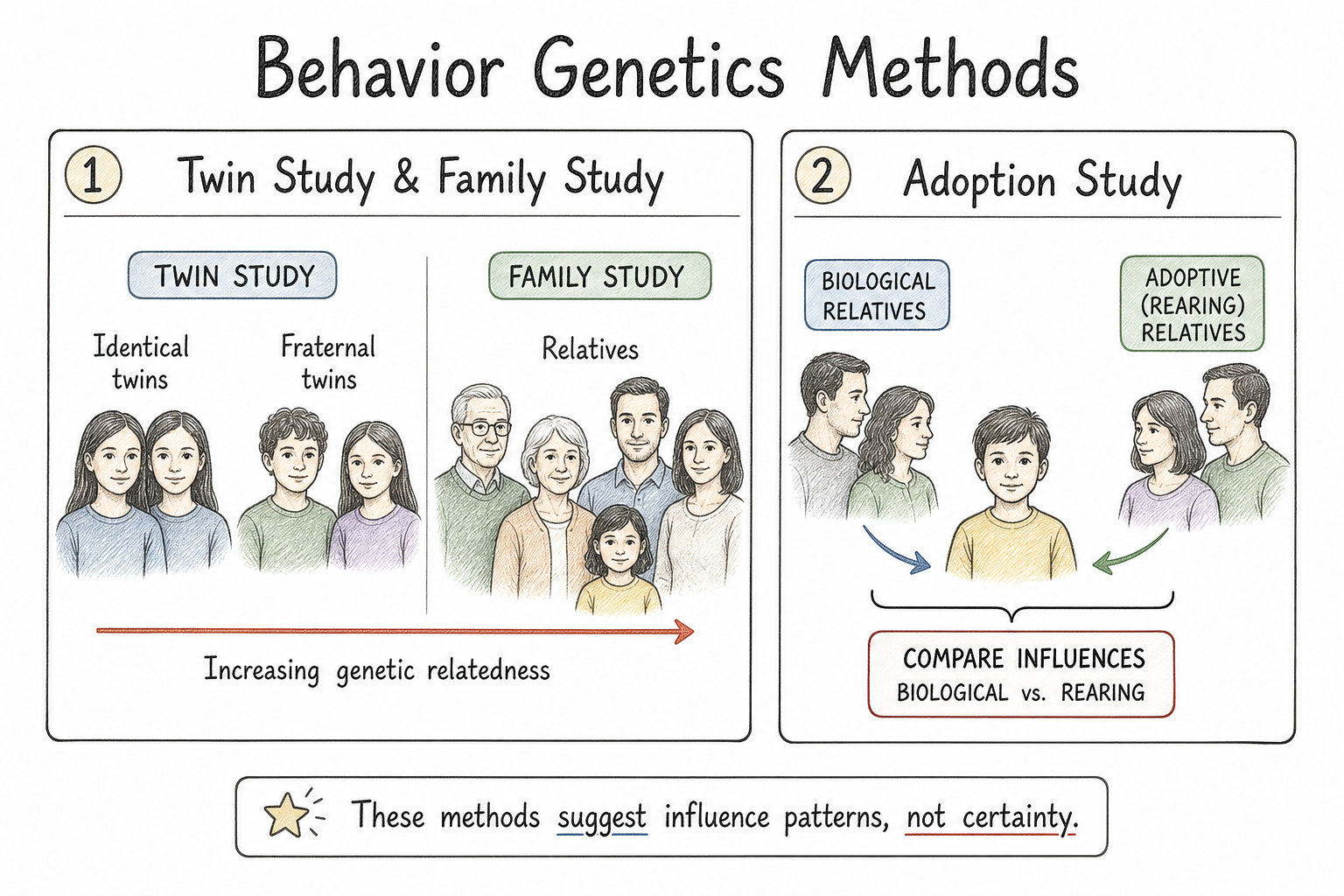
Behavior-Genetics Methods
Behavior genetics uses family patterns to estimate how heredity and environment relate to behavior. These designs show influence patterns, not single-cause certainty.
| Method | Comparison | What It Can Suggest | Limitation |
|---|---|---|---|
| Twin study | Identical twins compared with fraternal twins. | Greater similarity among identical twins can suggest genetic influence. | Twins may share environments in special ways. |
| Family study | Relatives with different degrees of genetic relatedness. | Traits that cluster with genetic relatedness may have hereditary influence. | Families often share environment too. |
| Adoption study | Adopted people compared with biological and adoptive relatives. | Can help separate biological similarity from rearing environment. | Adoption contexts are not random samples of all environments. |
Heritability with Precision
Heritability is a population statistic. It estimates how much variation in a trait within a studied population is associated with genetic differences. It is not a percentage of one person's behavior caused by genes.
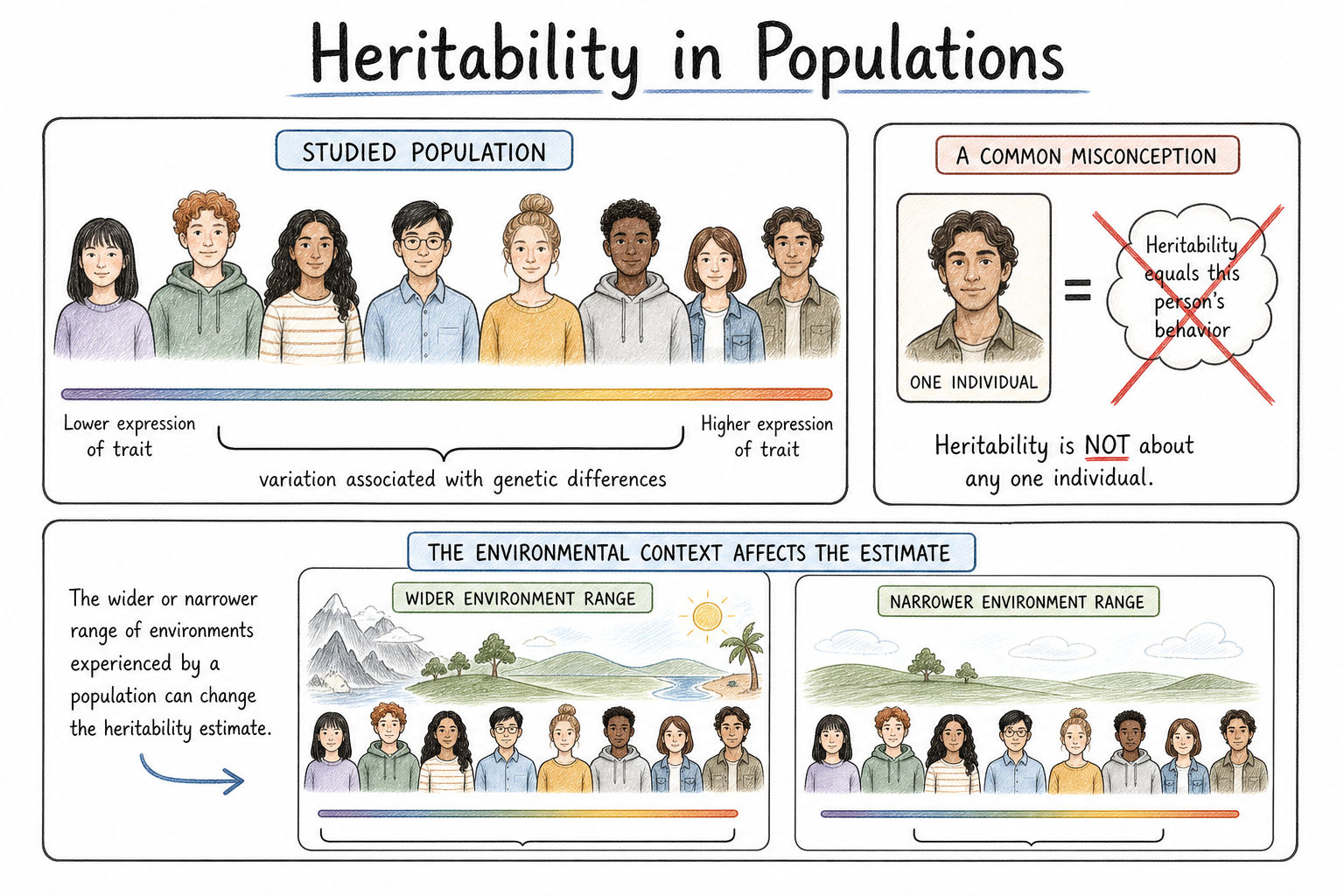
| Claim | Correct? | Why |
|---|---|---|
| Heritability describes variation in a group. | Yes. | It is about population differences under measured conditions. |
| A heritable trait cannot change. | No. | Environments can still shape expression. |
| High heritability means environment does not matter. | No. | Heritability depends on the range of environments studied. |
| Heritability tells what caused one student's behavior. | No. | It does not diagnose one individual. |
AP Scenario Decoder
| If the Prompt Mentions... | Think... | Answer Move |
|---|---|---|
| Biological relatives look more similar than adoptive relatives. | Genetic influence. | Explain similarity without saying genes are destiny. |
| A predisposition appears only under stress. | Heredity-environment interaction. | Name both the inherited risk and the triggering condition. |
| Survival or reproduction across generations. | Evolutionary perspective. | Connect the tendency to adaptive value carefully. |
| Ranking people by inherited traits. | Eugenics warning. | Reject the misuse and focus on ethical science. |
| Identical vs fraternal twins. | Twin study. | Use genetic similarity as the key comparison. |
Vocabulary
- Heredity: Inherited biological influence on traits and behavior.
- Environment: External experiences and conditions that shape development.
- Genetic predisposition: Inherited tendency that increases likelihood.
- Heredity-environment interaction: The combined influence of inherited tendencies and lived conditions.
- Evolutionary perspective: Explains some behavior by possible survival or reproductive value.
- Natural selection: Process by which adaptive traits become more common over generations.
- Eugenics: Harmful misuse of genetic ideas to justify discrimination or control.
- Twin study: Comparison of identical and fraternal twins.
- Family study: Study of traits among relatives with different genetic relatedness.
- Adoption study: Study comparing biological and rearing relatives.
- Heritability: Population statistic about variation associated with genetic differences.
Common Traps
- Destiny trap: Predisposition means likelihood, not guarantee.
- Either/or trap: AP usually wants both heredity and environment.
- Family-study trap: Similar relatives may share genes and environments.
- Evolution trap: Explaining a possible origin does not morally approve behavior.
- Heritability trap: Heritability is about group variation, not one person's fixed future.
Quick Check
You are ready when you can explain how a biological predisposition and an environmental condition combine, identify twin/family/adoption methods, and avoid deterministic heredity language.