Overview of the Nervous System
How does the body route information from the world, through the nervous system, and back into action?
The Core Idea
The nervous system is the body's fast communication network. It receives sensory input, processes information, and sends commands to muscles and glands.
Most AP questions in this topic are sorting questions: which part receives and processes? which part connects the body? which part controls voluntary movement? which part handles automatic arousal and calming?
System Map
Use this hierarchy before memorizing examples. It keeps the whole topic from turning into disconnected terms.
| Level | Branch | Main Job | AP Clue |
|---|---|---|---|
| Whole system | Nervous system | Communication through neural signals. | Information moves quickly through nerves and the brain. |
| Major division | Central nervous system | Brain and spinal cord process information. | Integration, decision, spinal reflex. |
| Major division | Peripheral nervous system | Nerves connect CNS with the body. | Signals travel to or from muscles, glands, and sensory receptors. |
| PNS branch | Somatic nervous system | Voluntary skeletal muscle movement. | Walking, typing, raising a hand. |
| PNS branch | Autonomic nervous system | Automatic body functions. | Heart rate, digestion, sweating, pupil change. |
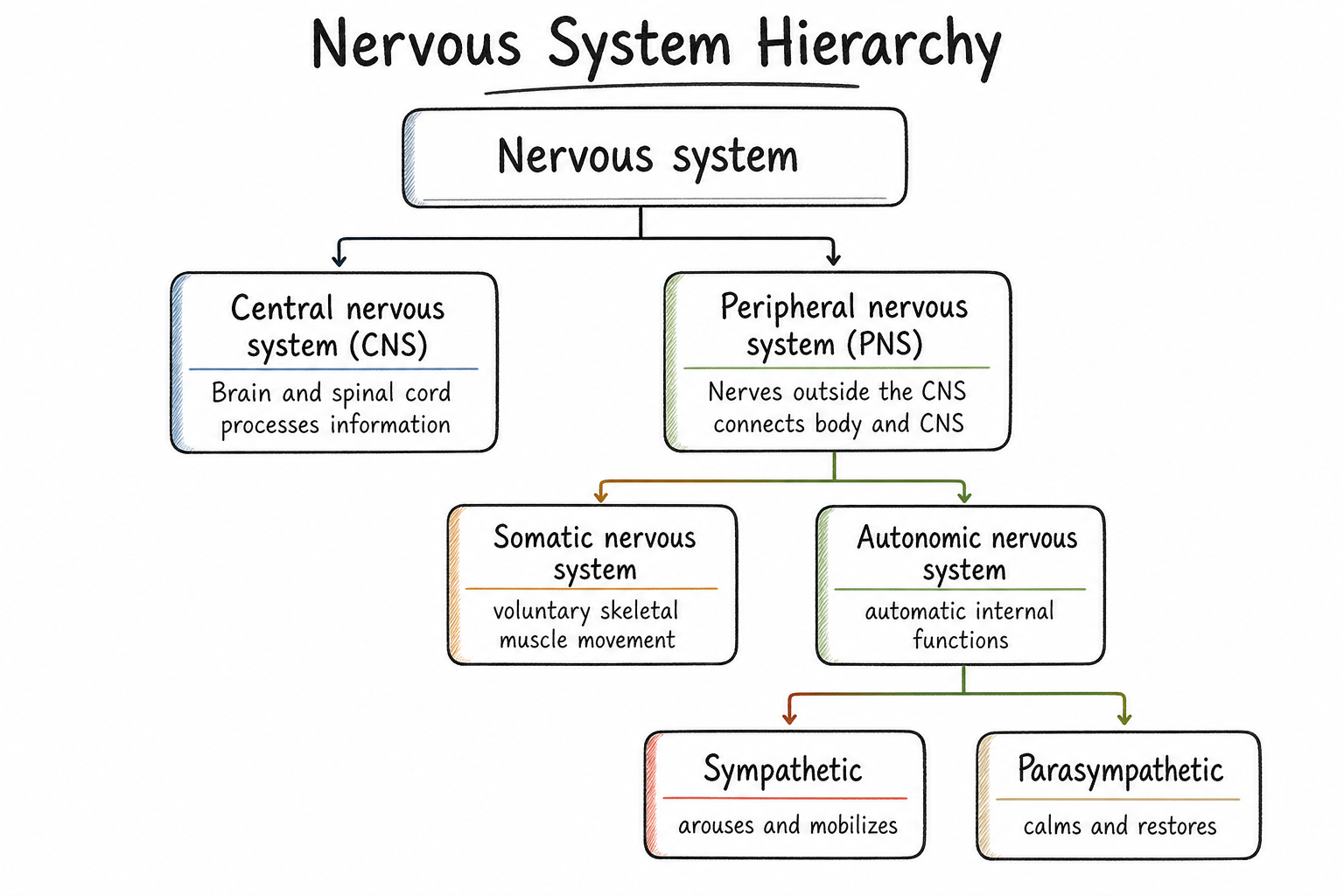
CNS and PNS
The CNS includes the brain and spinal cord. The PNS includes the nerves outside the brain and spinal cord.
| Division | Includes | Primary Role | Scenario Example |
|---|---|---|---|
| CNS | Brain and spinal cord. | Processes, coordinates, and integrates information. | The spinal cord helps coordinate a quick withdrawal reflex. |
| PNS | Nerves outside the CNS. | Carries information between body and CNS. | Sensory information from the skin travels toward the CNS. |
Memory move: Central means command center. Peripheral means pathways to and from the center.
Somatic and Autonomic
The PNS splits into voluntary movement and automatic regulation. This is one of the most tested close-call comparisons in the topic.
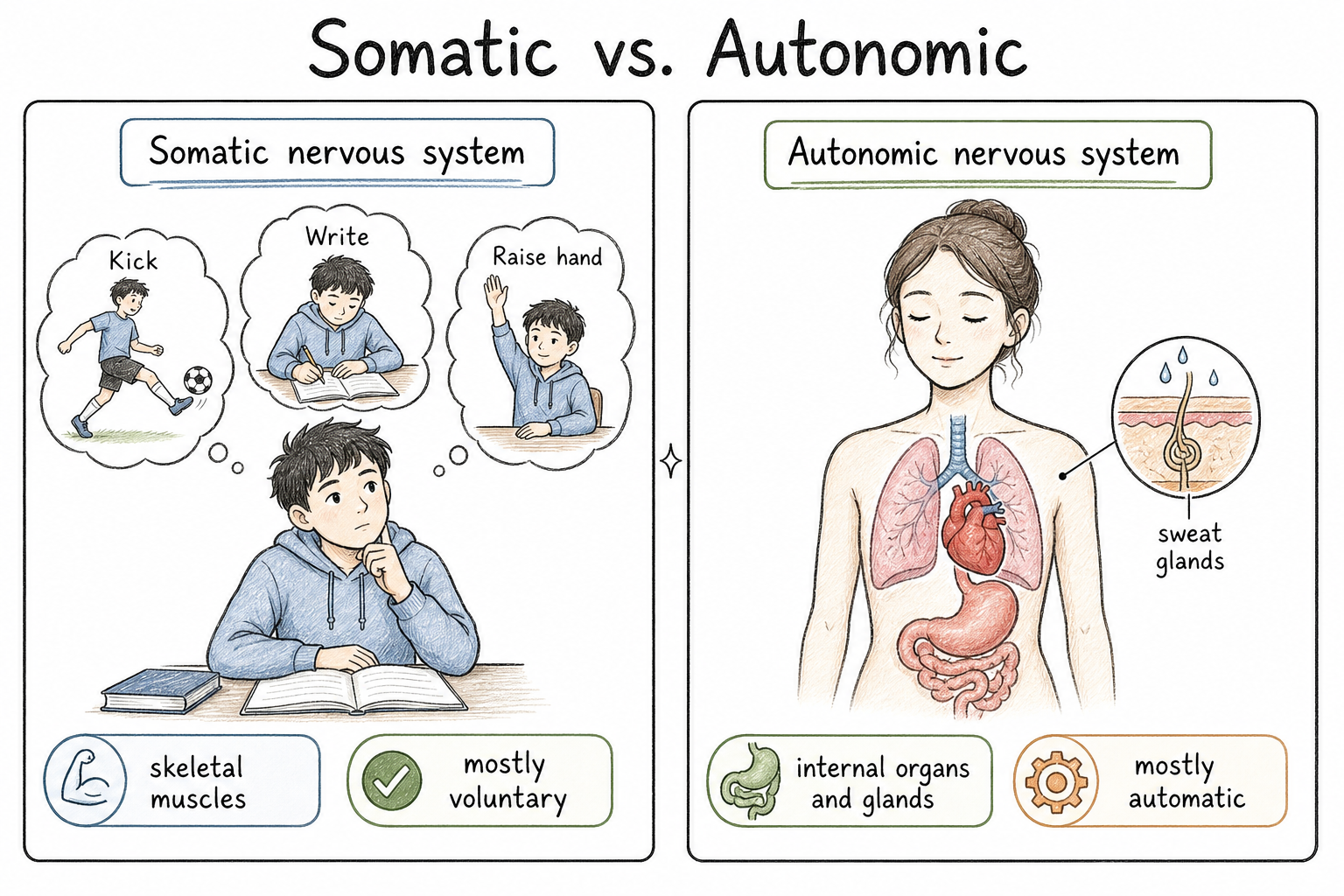
| PNS Branch | Controls | Voluntary? | AP Clue |
|---|---|---|---|
| Somatic nervous system | Skeletal muscles. | Mostly voluntary. | A person chooses to kick, write, speak, or move. |
| Autonomic nervous system | Internal organs and glands. | Mostly automatic. | Heart rate, breathing changes, digestion, sweating. |
Sympathetic and Parasympathetic
The autonomic nervous system has two balancing branches. The sympathetic branch mobilizes the body for action. The parasympathetic branch conserves energy and returns the body toward baseline.
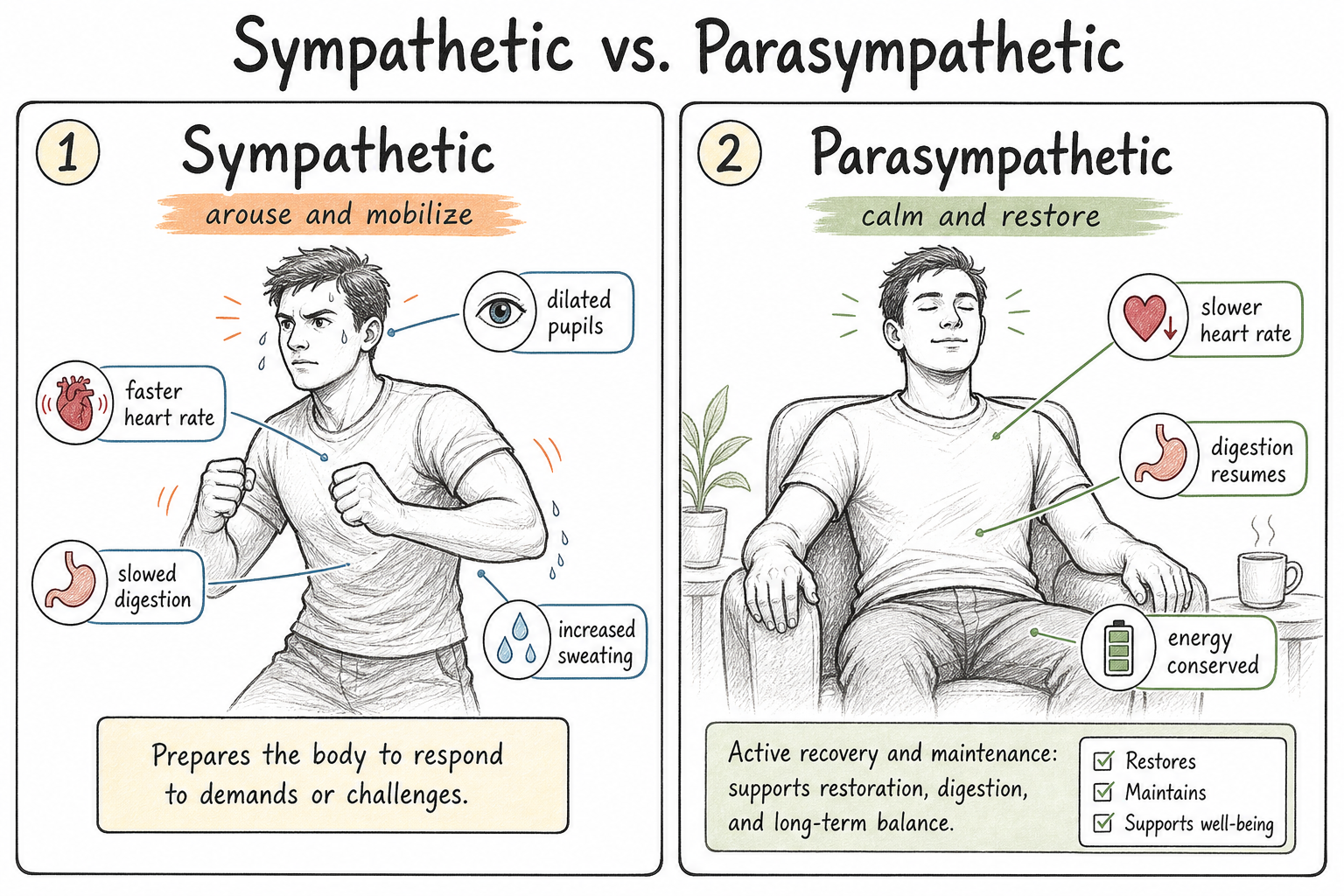
| Branch | Main Direction | Body Changes | Scenario Clue |
|---|---|---|---|
| Sympathetic | Arouse and mobilize. | Heart rate rises, pupils dilate, digestion slows, sweat increases. | Fear, stress, competition, emergency. |
| Parasympathetic | Calm and restore. | Heart rate slows, digestion resumes, energy is conserved. | Resting after danger, recovering after a scare. |
Do not write that the parasympathetic system "does nothing." It actively supports recovery and maintenance.
Signal Pathways
A good nervous-system explanation follows information as a route, not a vocabulary list.
| Route | Direction | Example | Key Branch |
|---|---|---|---|
| Sensory input | Body to CNS. | Skin receptors detect heat. | PNS carries input inward. |
| Processing | Within CNS. | Brain or spinal cord organizes a response. | CNS. |
| Voluntary output | CNS to skeletal muscle. | Student moves a hand away. | Somatic. |
| Automatic output | CNS to organs/glands. | Heart rate rises and sweating begins. | Autonomic. |
Stress Example
Imagine a student hears a loud crash. Sensory information travels through the PNS toward the CNS. The brain interprets possible danger. The sympathetic branch increases arousal. If the student decides to walk away, the somatic branch controls the voluntary movement. When the room is safe again, the parasympathetic branch helps the body settle.
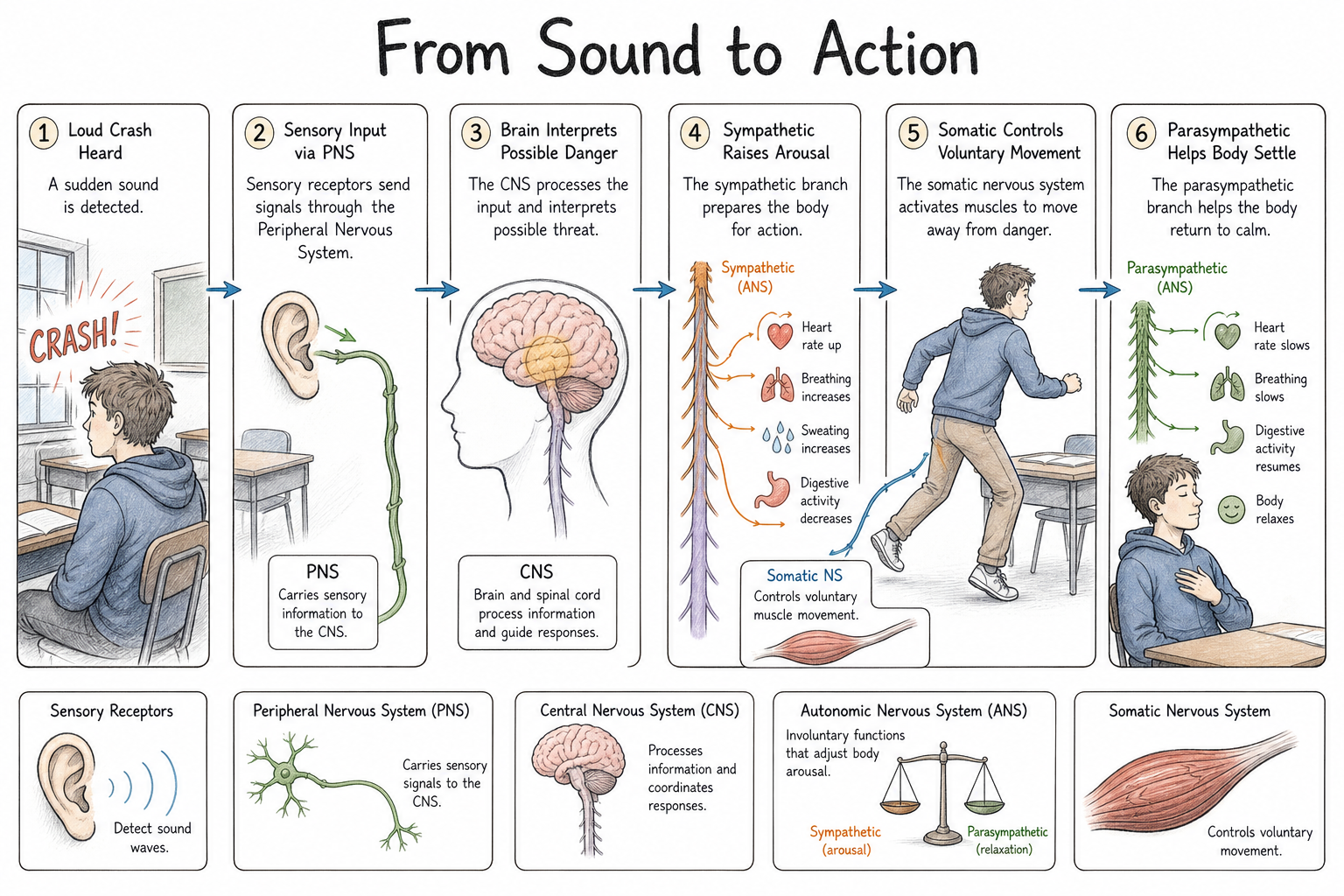
This one scene can test almost every term in the topic.
AP Close-Call Grid
| Close Call | Use This Difference | Fast Example |
|---|---|---|
| CNS vs PNS | Processing center vs connecting nerves. | Spinal cord vs nerve to leg. |
| Somatic vs autonomic | Voluntary skeletal movement vs automatic internal regulation. | Writing vs increased heart rate. |
| Sympathetic vs parasympathetic | Arouse vs calm/restore. | Racing heart vs digestion resuming. |
| Motor command vs sensory input | Output to muscles vs input from receptors. | Moving hand vs feeling heat. |
Vocabulary
- Nervous system: Fast communication system using neural signals.
- Central nervous system: Brain and spinal cord.
- Peripheral nervous system: Nerves outside the brain and spinal cord.
- Somatic nervous system: PNS branch controlling voluntary skeletal muscle movement.
- Autonomic nervous system: PNS branch controlling automatic internal functions.
- Sympathetic nervous system: Autonomic branch that mobilizes arousal.
- Parasympathetic nervous system: Autonomic branch that calms and restores.
Common Traps
- PNS trap: The PNS is outside the CNS, but it still communicates with the CNS.
- Autonomic trap: Autonomic does not mean emotional only; it includes automatic internal functions.
- Somatic trap: Somatic is about voluntary skeletal muscles, not the whole body.
- Parasympathetic trap: It does not "turn off" the body; it supports recovery and maintenance.
- Hierarchy trap: Sympathetic and parasympathetic are inside autonomic, which is inside PNS.
Quick Check
You are ready when you can draw the nervous-system hierarchy and classify a scenario as CNS, PNS, somatic, autonomic, sympathetic, or parasympathetic.