The Neuron and Neural Firing
How do neural cells send electrical signals inside a neuron and chemical messages between neurons?
The Core Idea
Neurons transmit information. Glial cells support neurons. Together they make nervous-system communication possible.
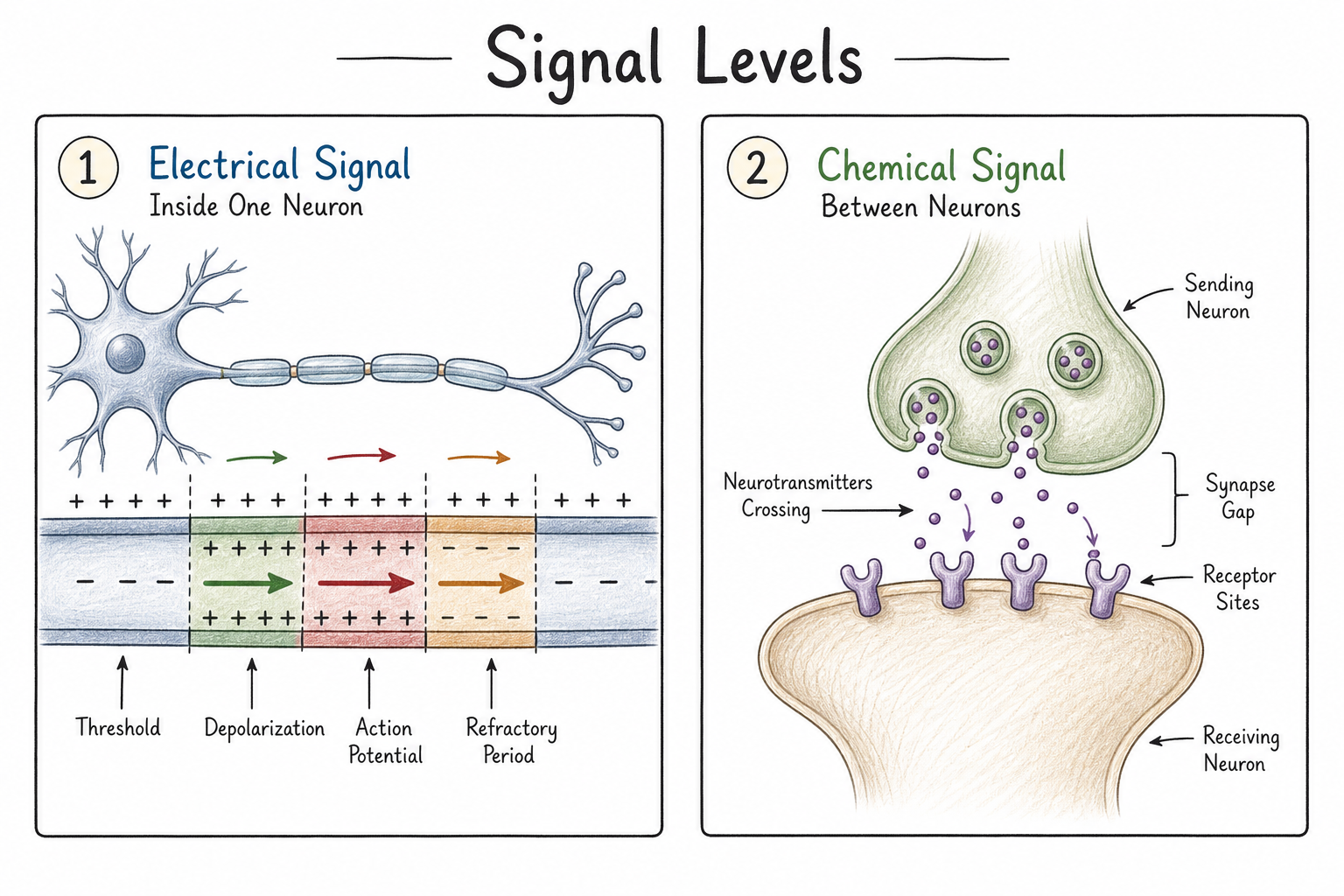
There are two communication levels: an electrical signal inside a neuron and a chemical signal across the synapse. Most mistakes in this topic come from mixing those two levels.
Neurons and Glia
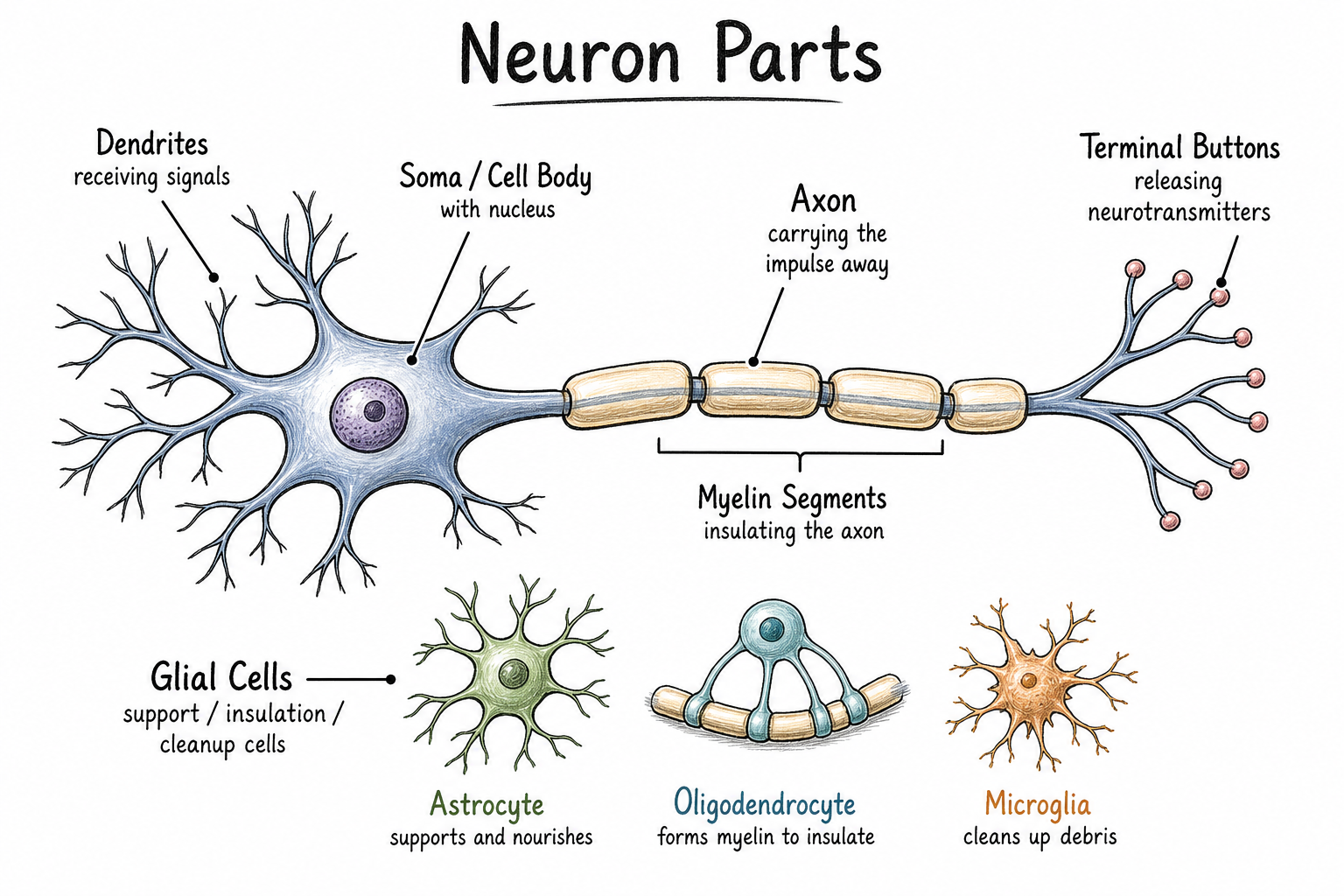
A neuron is not just a labeled diagram. It is a communication cell with parts that support receiving, firing, and sending messages.
| Cell or Part | AP-Level Job | Scenario Clue |
|---|---|---|
| Neuron | Transmits information. | A signal moves through the nervous system. |
| Glial cells | Support, insulate, help communication, and assist cleanup. | Support cells affect neural functioning. |
| Dendrites | Receive incoming signals. | Input side of the neuron. |
| Soma / cell body | Keeps the cell alive and contains the nucleus. | Cell maintenance and integration. |
| Axon | Carries the impulse away from the cell body. | Signal travels down the neuron. |
| Myelin | Insulates the axon and speeds communication. | Faster or disrupted transmission. |
| Terminal buttons | Release neurotransmitters. | Chemicals enter the synapse. |
Neuron Types and Reflex Arc
Neuron types are easiest when you follow direction. Sensory neurons bring input in, motor neurons send commands out, and interneurons connect inside the CNS.
| Neuron Type | Direction | Role in a Hot-Stove Reflex |
|---|---|---|
| Sensory neuron | Receptor to CNS. | Carries pain/heat information inward. |
| Interneuron | Within CNS. | Connects and processes in the spinal cord. |
| Motor neuron | CNS to muscle or gland. | Sends command to pull the hand away. |
A reflex arc can be fast because the spinal cord can coordinate the response before slower conscious awareness fully catches up.
Action Potential Sequence
An action potential is the electrical impulse that travels down a neuron. Learn the story in order.
| Step | Term | Meaning | AP Trap |
|---|---|---|---|
| 1 | Resting potential | Charged ready state before firing. | Ready is not the same as firing. |
| 2 | Threshold | Minimum stimulation needed to fire. | Weak input below threshold does not cause a partial firing. |
| 3 | Depolarization | Electrical change during firing. | Know the AP term, not ion chemistry. |
| 4 | Action potential | Electrical impulse travels down the axon. | The signal is inside the neuron here. |
| 5 | Refractory period | Brief recovery after firing. | The neuron resets before firing again. |
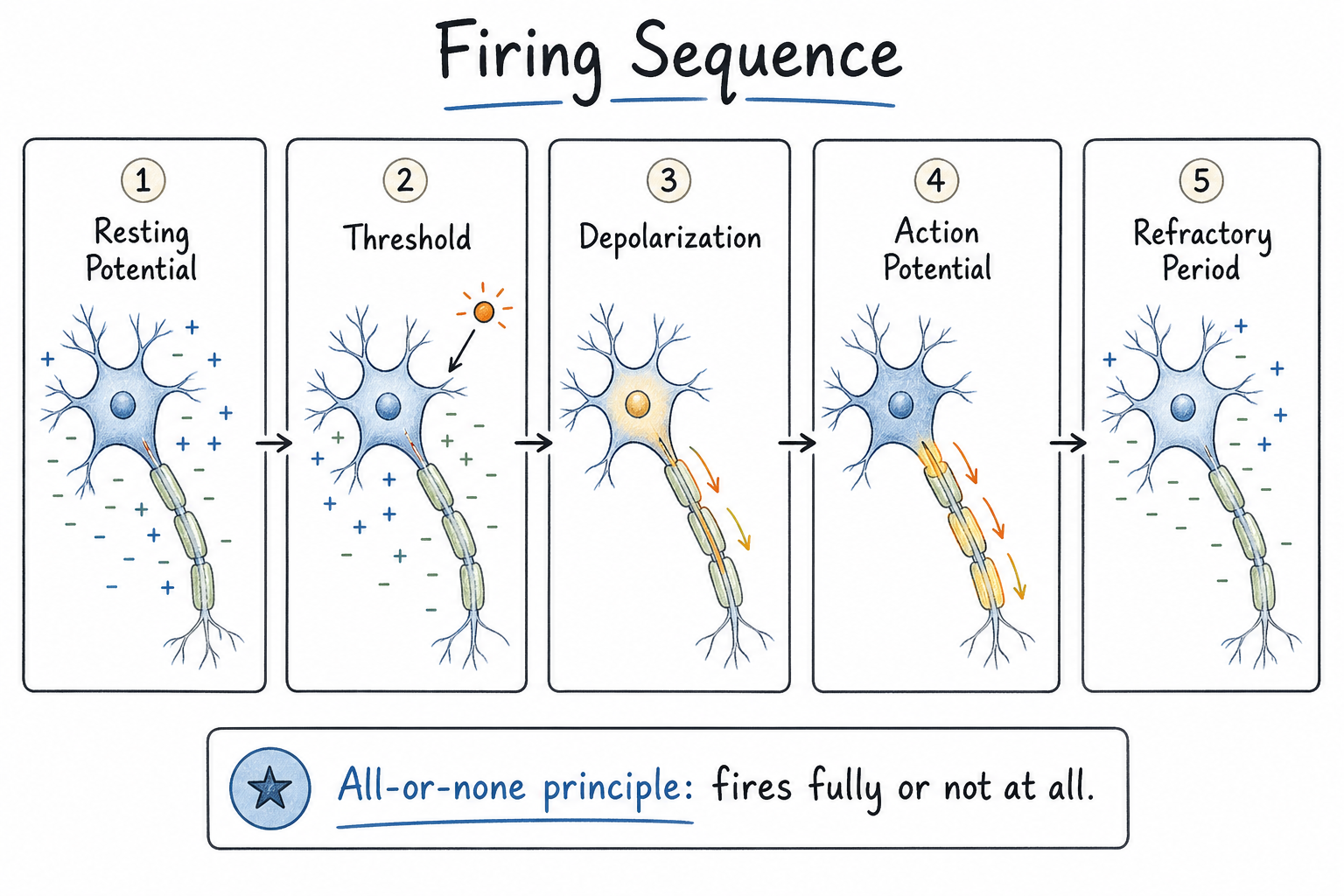
The all-or-none principle means a neuron fires fully if threshold is reached or does not fire if threshold is not reached.
Electrical vs Chemical
The simplest high-score sentence for this topic is: electricity travels down the neuron; chemicals cross the synapse.
| Location | Signal Type | Main Vocabulary | What Happens |
|---|---|---|---|
| Inside the neuron | Electrical. | Threshold, depolarization, action potential, refractory period. | The impulse travels along the axon. |
| Between neurons | Chemical. | Synapse, neurotransmitter, receptor, reuptake. | Chemicals cross the gap and affect the next neuron. |
Synapse and Neurotransmitters
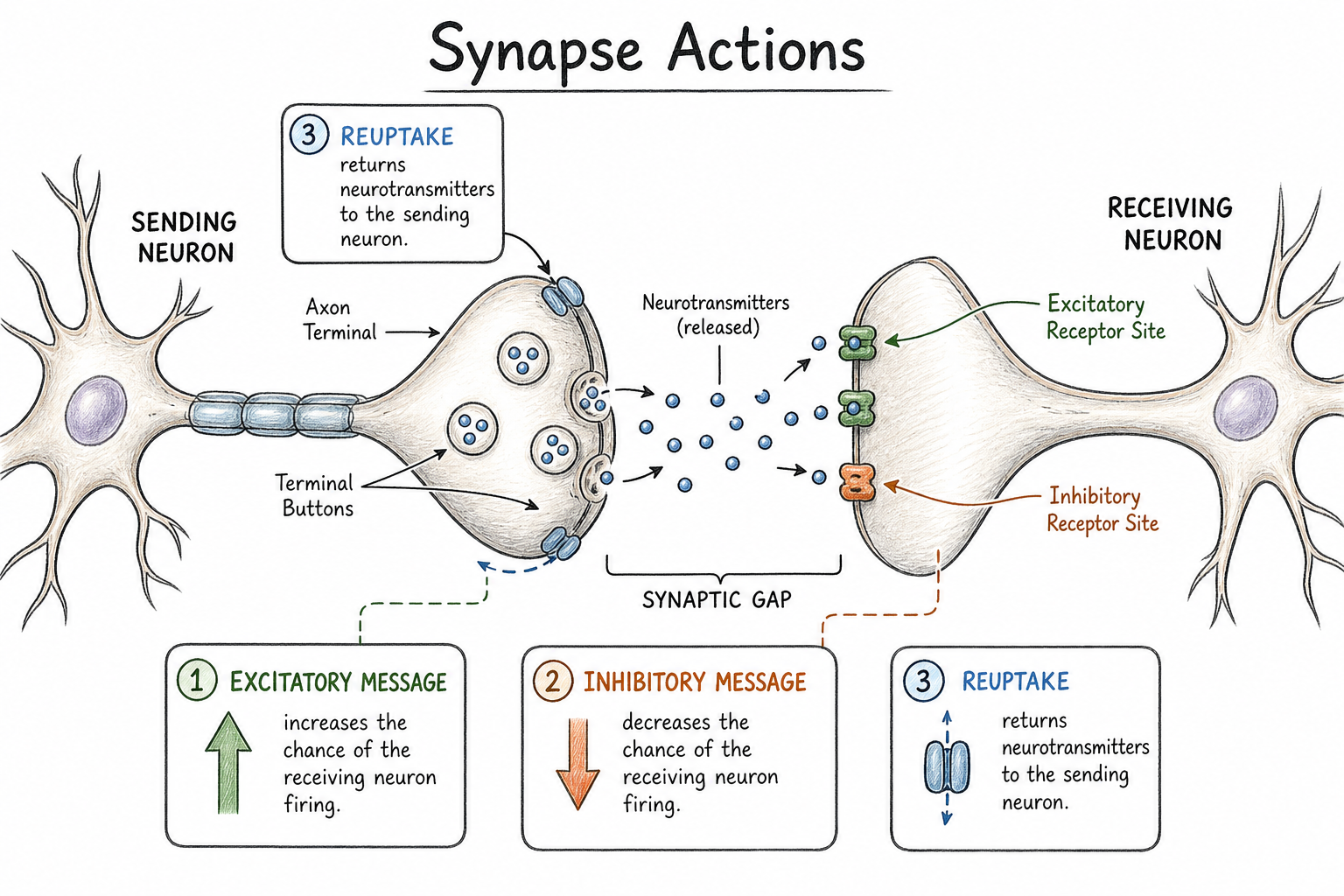
The synapse is the small gap between neurons. Neurotransmitters are chemical messengers released into that gap.
| Concept | Meaning | AP Clue |
|---|---|---|
| Excitatory message | Makes the next neuron more likely to fire. | Pushes toward threshold. |
| Inhibitory message | Makes the next neuron less likely to fire. | Pulls away from firing. |
| Receptor site | Location where neurotransmitters bind. | Chemical message affects the receiving neuron. |
| Reuptake | Neurotransmitter is taken back into the sending neuron. | Cleanup or recycling of the chemical signal. |
AP Neurotransmitter Set
The exam uses a limited neurotransmitter list. Effects can depend on location and receptor type, so avoid saying each neurotransmitter has only one job everywhere.
| Neurotransmitter | Common AP Association | Careful Wording |
|---|---|---|
| Dopamine | Reward, motivation, movement, attention. | Often linked to reward and movement pathways. |
| Serotonin | Mood, sleep, appetite, pain sensitivity. | Often linked to mood and sleep regulation. |
| Norepinephrine | Alertness, arousal, stress response. | Often linked to attention and arousal. |
| Glutamate | Major excitatory neurotransmitter, learning and memory. | Excitatory does not mean "always good." |
| GABA | Major inhibitory neurotransmitter. | Inhibitory can be protective and calming. |
| Endorphins | Pain relief and pleasure. | Body's pain-relief chemicals. |
| Substance P | Pain signaling. | P for pain is a useful cue. |
| Acetylcholine | Muscle action, learning, memory. | Important at muscles and in memory-related systems. |
Hormones and Drug Mechanisms
Hormones are chemical messengers that generally travel through the bloodstream and often act more slowly than neurotransmitters.
| Hormone | AP Association |
|---|---|
| Adrenaline | Arousal and emergency response. |
| Leptin | Satiety and energy regulation. |
| Ghrelin | Hunger. |
| Melatonin | Sleep timing. |
| Oxytocin | Bonding, trust, and some reproductive processes. |
| Drug Mechanism | Effect on Neurotransmission | AP Clue |
|---|---|---|
| Agonist | Mimics or increases neurotransmitter action. | More of the signal's effect. |
| Antagonist | Blocks or reduces neurotransmitter action. | Less of the signal's effect. |
| Reuptake inhibitor | Blocks reabsorption, leaving more neurotransmitter active in the synapse. | More chemical remains available in the gap. |
Psychoactive Drug Classes
Psychoactive drugs affect behavior and mental processes by changing neural communication.
| Class | Typical Effect | Examples in AP-Style Wording |
|---|---|---|
| Stimulants | Increase neural activity or arousal. | Caffeine, cocaine. |
| Depressants | Decrease neural activity or arousal. | Alcohol. |
| Hallucinogens | Distort perception or cognition. | Marijuana in AP wording. |
| Opioids | Act as pain relievers and can create strong dependence risk. | Heroin. |
Tolerance is reduced response after repeated use. Addiction is compulsive use despite harm. Withdrawal is physical or psychological symptoms when use stops.
AP Scenario Decoder
| If the Prompt Mentions... | Think... | Why |
|---|---|---|
| A stimulus must reach a minimum level. | Threshold. | Firing requires enough stimulation. |
| No half firing. | All-or-none principle. | The neuron either fires fully or does not fire. |
| Chemicals crossing a gap. | Neurotransmitters at the synapse. | Between-neuron communication is chemical. |
| A drug blocks receptors. | Antagonist. | It reduces neurotransmitter action. |
| A drug leaves more chemical in the synapse. | Reuptake inhibitor. | It blocks reabsorption. |
| Myelin damage. | Disrupted neural transmission. | Insulation affects signal speed and reliability. |
Vocabulary
- Neuron: Cell that transmits information.
- Glial cells: Cells that support neural function.
- Sensory neuron: Carries input toward the CNS.
- Motor neuron: Carries commands from CNS to muscles or glands.
- Interneuron: Connects and processes within the CNS.
- Reflex arc: Fast response pathway often involving the spinal cord.
- Resting potential: Charged ready state.
- Threshold: Minimum stimulation needed to fire.
- Action potential: Electrical impulse down the neuron.
- Synapse: Gap between neurons.
- Neurotransmitter: Chemical messenger crossing the synapse.
- Reuptake: Reabsorption into the sending neuron.
- Agonist: Mimics or increases neurotransmitter action.
- Antagonist: Blocks or reduces neurotransmitter action.
Common Traps
- Electrical/chemical trap: Electrical inside the neuron, chemical across the synapse.
- All-or-none trap: Stronger stimulation does not create a bigger individual action potential.
- Neurotransmitter trap: Effects depend on location and receptor context.
- Agonist/antagonist trap: Agonist increases or mimics; antagonist blocks or reduces.
- Hormone trap: Hormones usually travel through the bloodstream and can act more slowly.
- Scope trap: Sodium-potassium detail is not the AP® Psychology target here.
Quick Check
You are ready when you can explain a neural signal from dendrite to synapse, sort neurotransmitter and hormone examples, and distinguish agonist, antagonist, and reuptake inhibitor effects.