The Brain
How do brain structures, cortical areas, and research evidence connect biological systems to behavior?
The Core Idea
The brain is not a pile of memorized locations. It is a set of interacting systems that regulate survival, emotion, memory, movement, language, sensation, and flexible thinking.
A strong AP answer connects the structure to a specific function and then applies that function to the scenario.
Survival, Arousal, Reward, and Coordination
| Structure | Main Function | AP Clue |
|---|---|---|
| Brain stem / medulla | Basic life functions such as breathing and heart activity. | Damage threatens survival functions. |
| Reticular activating system | Arousal, alertness, and wakefulness. | Sleepiness, coma, alertness, attention to incoming stimulation. |
| Reward center | Reinforcement and motivation pathways. | Behavior becomes more likely because it feels rewarding. |
| Cerebellum | Coordination, balance, and smooth movement. | Clumsy movement, balance problems, motor coordination. |
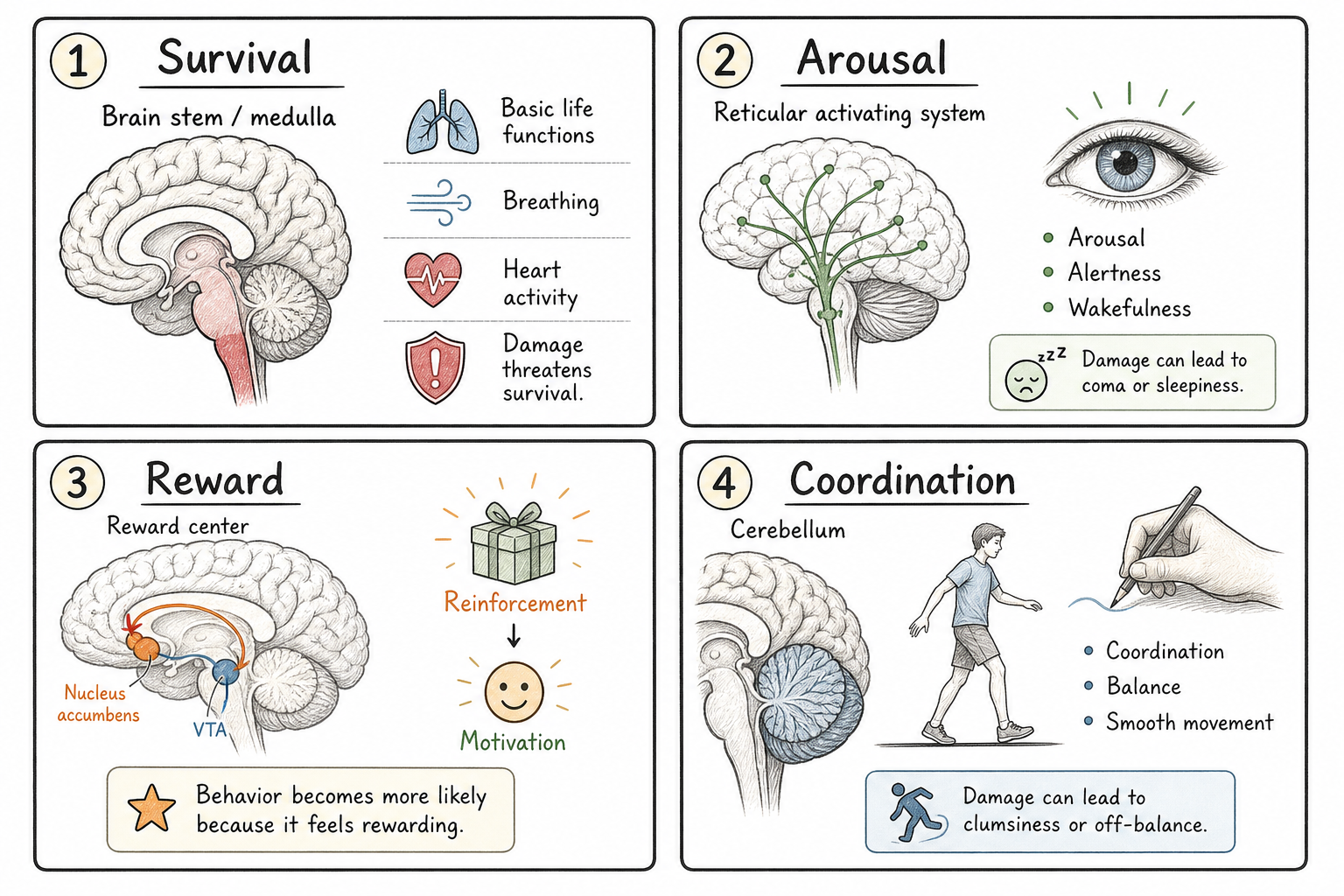
AP move: Do not say the cerebellum "causes movement" generally. Say it coordinates and smooths movement.
Limbic and Endocrine Links
Several brain structures connect emotion, memory, sensory routing, and hormone regulation.
| Structure | Function | Scenario Clue |
|---|---|---|
| Thalamus | Routes most sensory information toward the cortex. | Sensory relay station. |
| Hypothalamus | Regulates hunger, thirst, temperature, and endocrine activity. | Body balance, motivated states, hormone control. |
| Pituitary gland | Master gland influenced by the hypothalamus. | Hormonal messages affect other glands. |
| Hippocampus | Forms new explicit memories. | Difficulty making new memories after damage. |
| Amygdala | Emotion processing, especially fear and threat. | Fear response, emotional learning. |
Cortex and Lobes
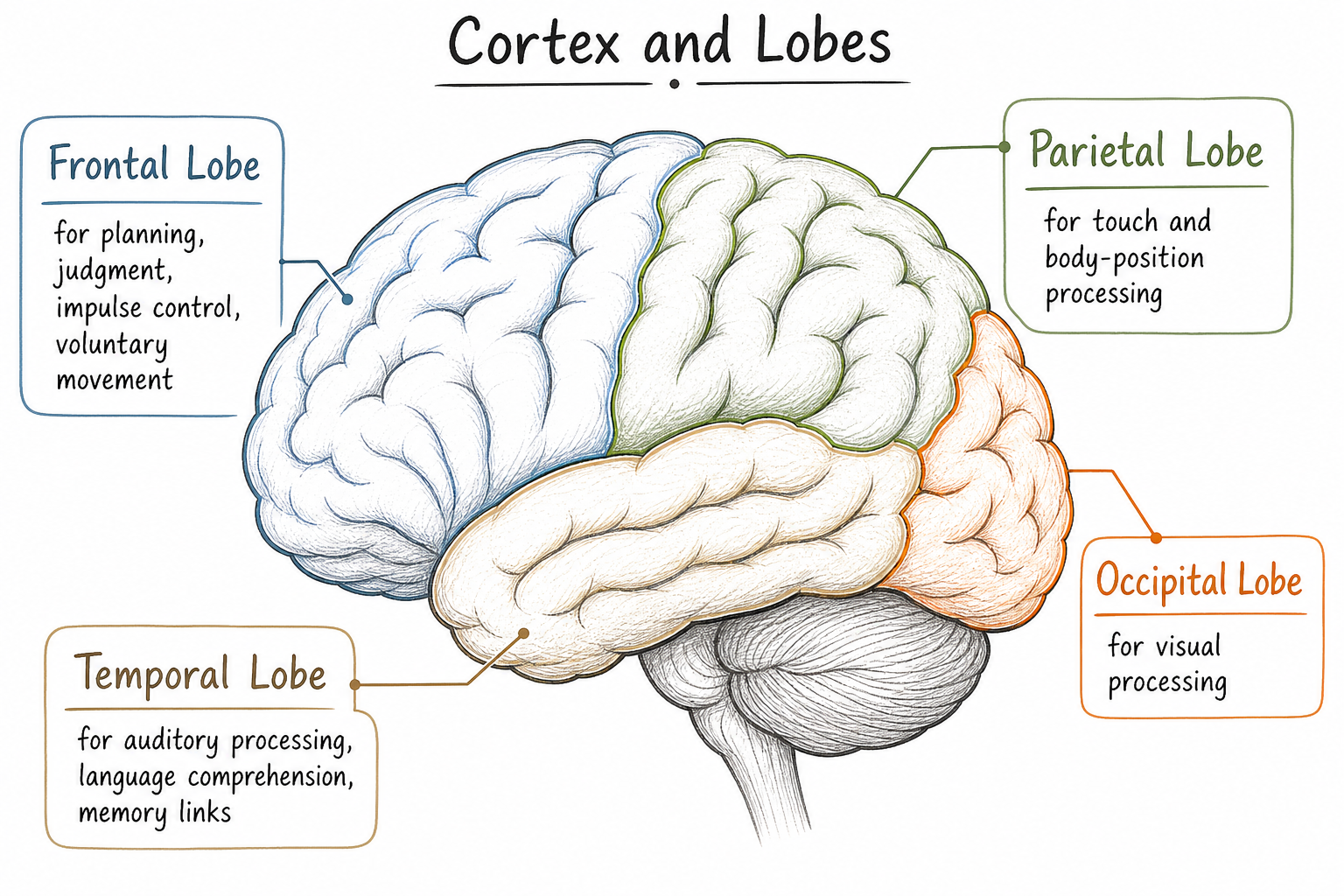
The cerebral cortex supports higher mental processes and specialized processing areas.
| Lobe | Core Functions | AP Clue |
|---|---|---|
| Frontal lobe | Planning, judgment, impulse control, voluntary movement. | Decision-making or personality change after damage. |
| Parietal lobe | Touch and body-position processing. | Somatosensory information. |
| Occipital lobe | Visual processing. | Vision and visual cortex. |
| Temporal lobe | Auditory processing, language comprehension, memory links. | Hearing, speech understanding, temporal cortex. |
 Open Interactive Brain Structure
Motor and Somatosensory Strips
| Cortical Area | Location Cue | Function | Example |
|---|---|---|---|
| Motor cortex | Frontal lobe. | Controls voluntary movement. | Moving fingers to type. |
| Somatosensory cortex | Parietal lobe. | Processes touch and body sensations. | Feeling pressure on a hand. |
The body is mapped unevenly on these strips. Areas needing fine control or sensitivity get more cortical space.
Language and Hemispheres
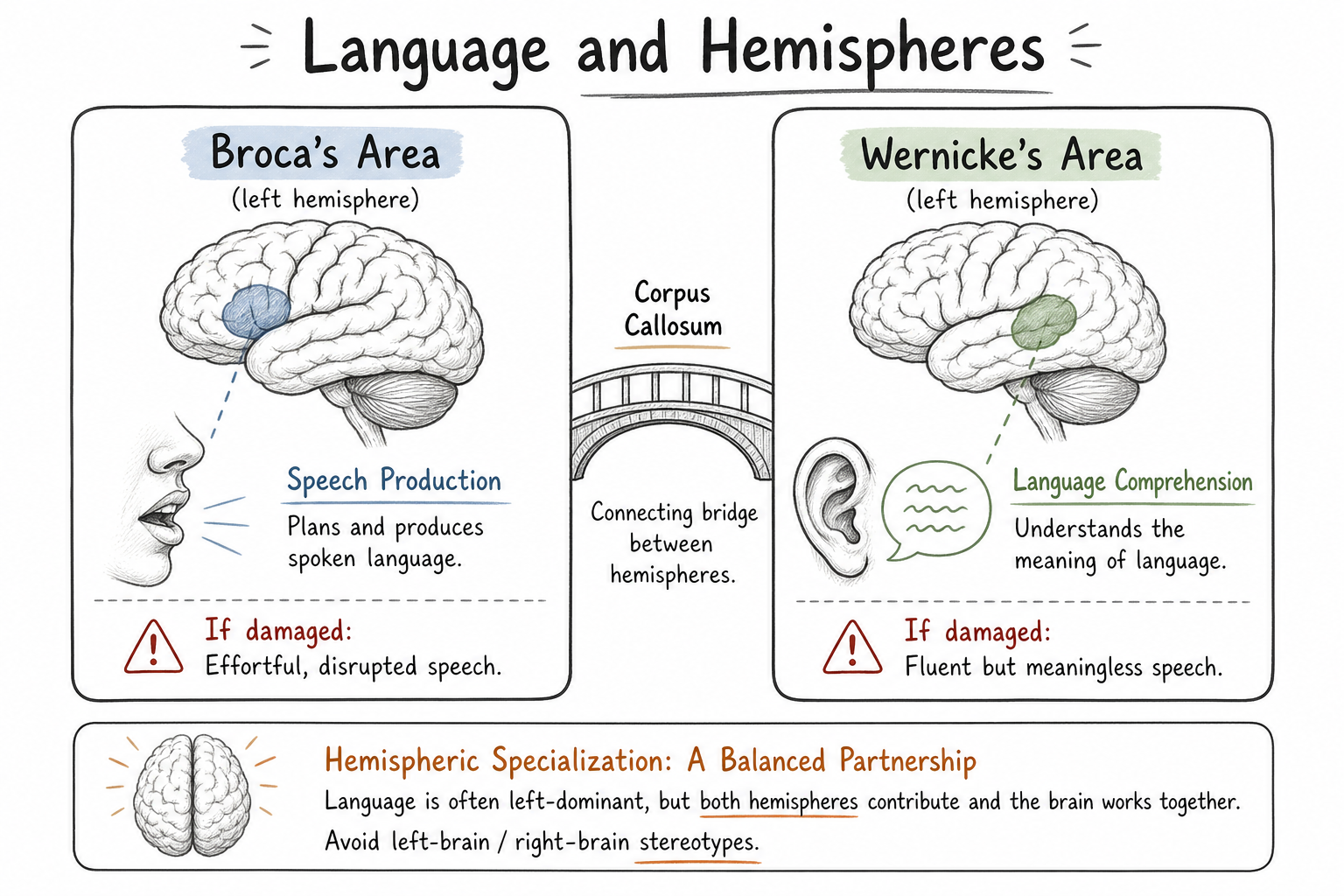
Language is often left-hemisphere dominant, but avoid pop-science claims that one side is purely logical and the other is purely creative.
| Area or Concept | Main Function | Damage or Evidence Clue |
|---|---|---|
| Broca's area | Speech production. | Effortful, disrupted speech production. |
| Wernicke's area | Language comprehension. | Fluent but meaningless speech or poor understanding. |
| Corpus callosum | Connects the two hemispheres. | Split-brain research separates information flow. |
| Hemispheric specialization | Some functions are more dominant in one hemisphere. | Language often left-dominant, but brains work together. |
Plasticity and Research Methods
Plasticity is the brain's ability to change with experience or after damage. It is strongest in development but remains relevant throughout life.
| Research Method | What It Shows | Best AP Use |
|---|---|---|
| Lesion or damage evidence | What changes when an area is damaged. | Link structure to lost function. |
| EEG | Electrical brain activity over time. | Sleep stages and timing of brain responses. |
| CT or MRI | Brain structure. | Locate damage or anatomy. |
| fMRI or PET | Activity patterns during tasks. | Show active areas while behavior occurs. |
AP Scenario Decoder
| If the Prompt Mentions... | Think... | Why |
|---|---|---|
| Breathing or heartbeat disruption. | Brain stem / medulla. | Basic survival functions. |
| Fear learning or threat response. | Amygdala. | Emotion and fear processing. |
| New explicit memory formation. | Hippocampus. | Memory consolidation. |
| Planning and impulse control. | Frontal lobe. | Executive function. |
| Visual processing. | Occipital lobe. | Vision. |
| Speech production problem. | Broca's area. | Producing spoken language. |
| Language comprehension problem. | Wernicke's area. | Understanding language. |
Vocabulary
- Brain stem / medulla: Basic life-function control.
- Reticular activating system: Arousal and alertness.
- Cerebellum: Coordination and balance.
- Thalamus: Sensory relay.
- Hypothalamus: Body regulation and endocrine link.
- Pituitary gland: Master gland influenced by the hypothalamus.
- Hippocampus: New explicit memory formation.
- Amygdala: Emotion and fear processing.
- Cerebral cortex: Higher processing outer layer.
- Broca's area: Speech production.
- Wernicke's area: Language comprehension.
- Corpus callosum: Connection between hemispheres.
- Plasticity: Brain change with experience or after damage.
Common Traps
- Left/right-brain trap: Avoid simplistic "left logical, right creative" claims.
- Cerebellum trap: It coordinates movement; it is not the main voluntary command center.
- Thalamus trap: Think sensory relay, not hormone command.
- Hypothalamus/pituitary trap: Hypothalamus regulates; pituitary releases many hormonal signals.
- Broca/Wernicke trap: Broca produces; Wernicke understands.
Quick Check
You are ready when you can match a behavior, symptom, or research clue to the most relevant brain structure and explain the function in one precise sentence.