Sleep
How do circadian rhythm, sleep stages, dreams, and sleep disorders connect biology to behavior?
The Core Idea
Consciousness is awareness of self and environment. Sleep is an altered state of consciousness with organized biological patterns, not simply "turning off."
Sleep is regulated by biological rhythm, brain activity, and body needs. The exam expects you to connect sleep stages and disorders to evidence such as EEG patterns and symptoms.
Circadian Rhythm
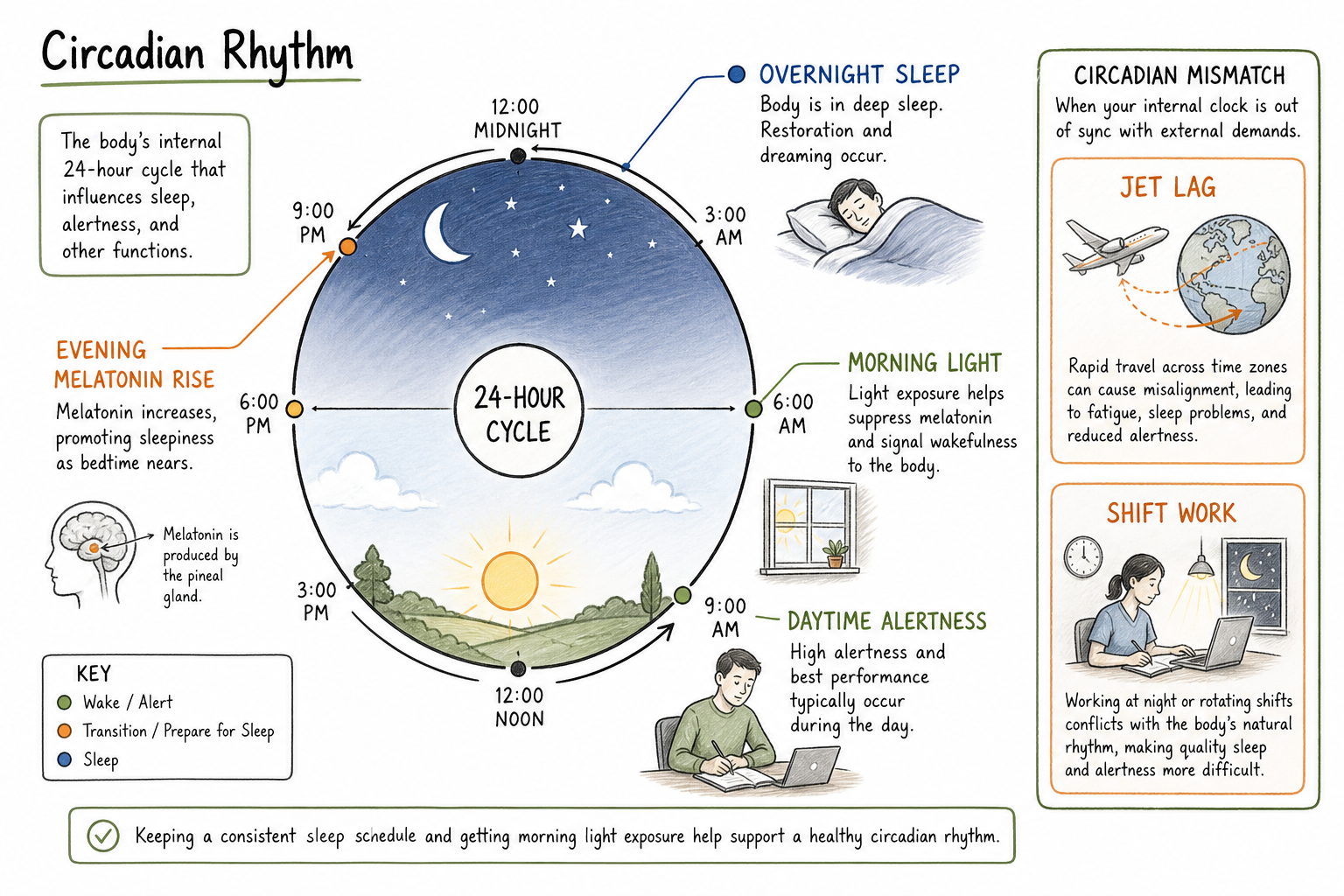
A circadian rhythm is an approximately 24-hour biological cycle. Light, routine, travel, shift work, and melatonin timing can affect it.
| Term | Meaning | AP Clue |
|---|---|---|
| Circadian rhythm | Daily biological rhythm. | Sleep timing changes across day/night. |
| Melatonin | Hormone linked to sleep timing. | Darkness, bedtime rhythm, jet lag adjustment. |
| Jet lag | Circadian rhythm mismatch after travel. | Body clock does not match local time. |
| Shift work | Work schedule conflicts with natural rhythm. | Alertness and sleep problems from timing mismatch. |
Sleep Stages and EEG
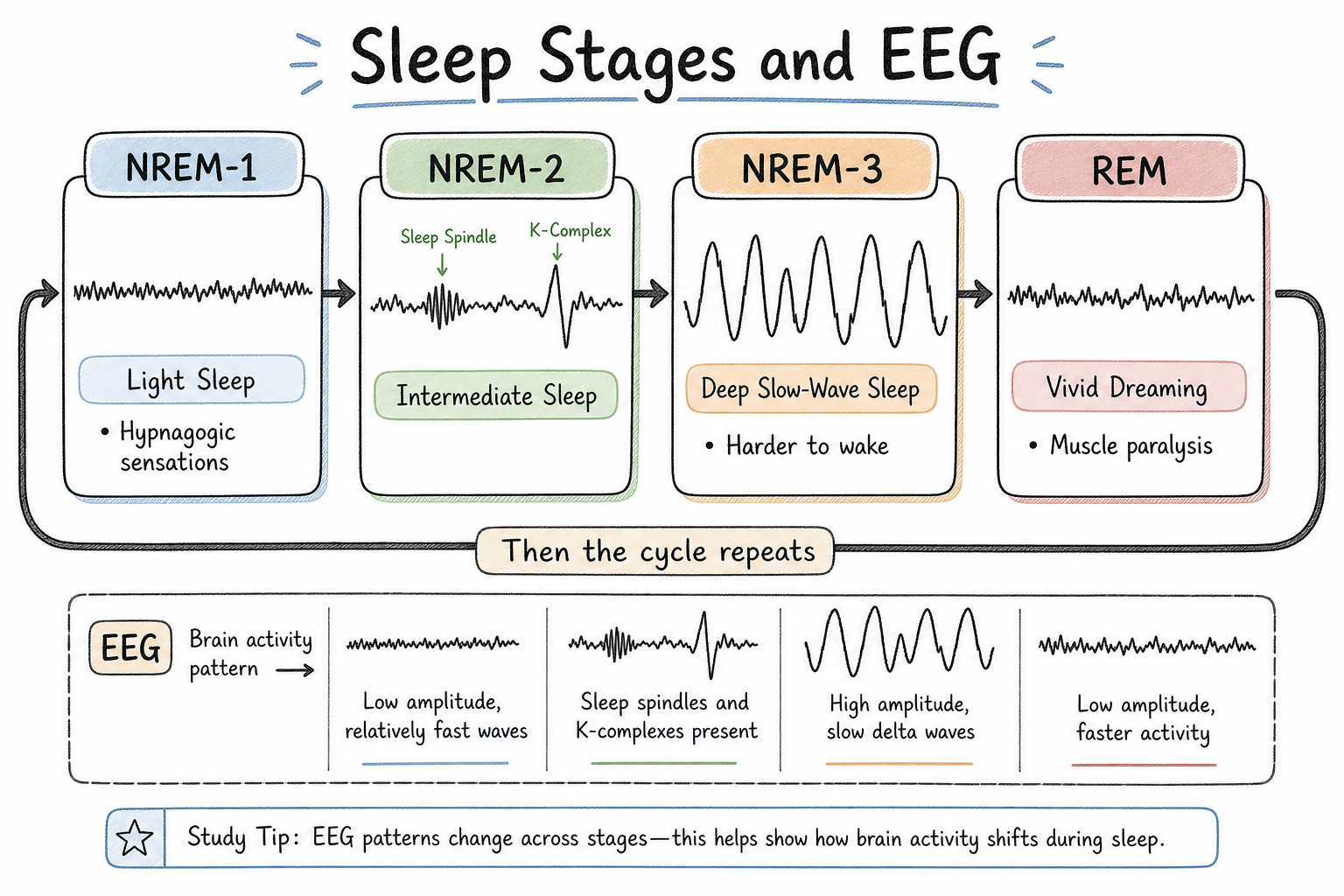
EEG records electrical brain activity and helps distinguish sleep stages. Sleep cycles through NREM and REM repeatedly during the night.
| Stage or State | Key Features | AP Clue |
|---|---|---|
| NREM sleep | Non-REM stages, including deeper sleep. | Body restoration and slow-wave sleep clues. |
| NREM-1 | Light sleep; hypnagogic sensations can occur. | Floating, falling, or brief sensory experiences. |
| NREM-2 | Intermediate sleep with recognizable EEG patterns. | Most of the night includes lighter NREM cycles. |
| NREM-3 | Deep sleep, slow-wave sleep. | Harder to wake; restoration clues. |
| REM sleep | Rapid eye movement, vivid dreaming, body paralysis. | Dreaming plus active brain and paralyzed body. |
REM and Paradoxical Sleep
REM sleep is sometimes called paradoxical sleep because the brain is active while the body is largely immobilized.
| REM Feature | Why It Matters | AP Trap |
|---|---|---|
| Rapid eye movement | Visible sign of REM stage. | REM is not the only time dreaming can occur, but it is strongly linked to vivid dreams. |
| Brain activity | Explains the "paradoxical" label. | Active brain does not mean awake. |
| Muscle paralysis | Prevents acting out most dreams. | Body stillness is part of REM. |
| REM rebound | REM increases after REM deprivation. | The body compensates for lost REM. |
Dream Theories and Functions
Dream theories are not interchangeable. Watch whether the prompt emphasizes hidden wishes, brain activation, memory, emotion, or threat practice.
| Idea | Core Claim | Prompt Clue |
|---|---|---|
| Manifest content | The remembered storyline of a dream. | What the dream seems to be about. |
| Latent content | Possible hidden meaning. | Psychoanalytic interpretation. |
| Activation-synthesis | Brain tries to make sense of random neural activation. | Dream story built from brain activity. |
| Information processing | Sleep helps memory and learning. | Studying, practice, memory consolidation. |
| Emotion regulation | Dreaming may help process emotion. | Stressful experiences and emotional adjustment. |
Sleep Functions
Sleep supports restoration, learning, memory, immune functioning, emotional regulation, and attention. Sleep deprivation can affect reaction time, mood, concentration, health, and safety.
| Function | Student-Facing Meaning | AP Clue |
|---|---|---|
| Restoration | Body and brain recover. | Fatigue, immune function, physical repair. |
| Memory consolidation | Learning is strengthened. | Sleep after studying improves retention. |
| Emotion regulation | Mood and stress responses are affected. | Irritability after poor sleep. |
| Attention and safety | Alertness and reaction time depend on sleep. | Drowsy driving or poor concentration. |
AP-Listed Sleep Disorders
| Disorder | Main Feature | AP Clue |
|---|---|---|
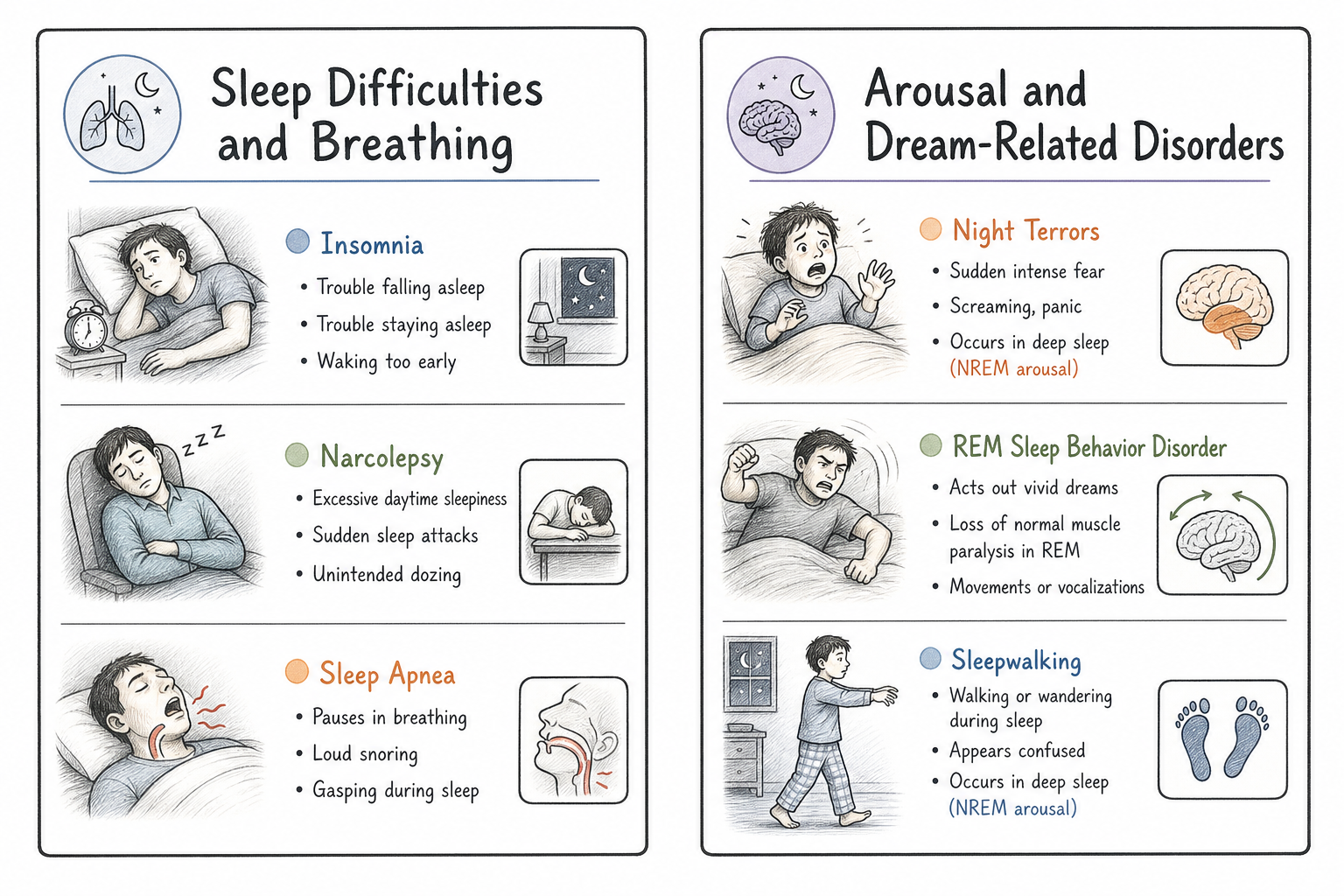
| Insomnia | Difficulty falling asleep, staying asleep, or feeling rested. | Persistent sleep difficulty. |
| Narcolepsy | Sudden sleep attacks or REM-like intrusion. | Unexpected sleep episodes. |
| Sleep apnea | Breathing interruptions during sleep. | Snoring, choking, daytime sleepiness. |
| Night terrors | Intense arousal, often in deep NREM sleep, with little memory. | Child wakes panicked and later remembers little. |
| REM sleep behavior disorder | Acting out dreams because REM paralysis is disrupted. | Dream enactment and movement during REM. |
| Sleepwalking | Walking or activity during sleep, often NREM. | Person moves while asleep and may remember little. |
AP Scenario Decoder
| If the Prompt Mentions... | Think... | Why |
|---|---|---|
| Body clock disrupted by travel. | Circadian rhythm / jet lag. | Timing mismatch. |
| Falling sensation while drifting off. | Hypnagogic sensation. | Early light sleep. |
| Active brain and paralyzed body. | REM / paradoxical sleep. | REM has wake-like activity with muscle paralysis. |
| More REM after being deprived. | REM rebound. | Compensation for missed REM. |
| Breathing stops during sleep. | Sleep apnea. | Respiratory interruptions. |
| Sudden sleep episodes. | Narcolepsy. | Sleep attacks. |
Vocabulary
- Consciousness: Awareness of self and environment.
- Circadian rhythm: Approximately 24-hour biological cycle.
- Melatonin: Hormone linked to sleep timing.
- EEG: Recording of electrical brain activity.
- NREM sleep: Non-REM sleep stages.
- REM sleep: Rapid-eye-movement sleep linked to vivid dreaming and muscle paralysis.
- Paradoxical sleep: REM sleep; active brain with immobilized body.
- REM rebound: Increased REM after REM loss.
- Insomnia: Persistent sleep difficulty.
- Narcolepsy: Sudden sleep episodes.
- Sleep apnea: Breathing interruptions during sleep.
- Night terrors: Intense NREM arousal with little recall.
Common Traps
- REM trap: REM is not simply "deep sleep"; it is active-brain sleep with paralysis.
- Night terror/nightmare trap: Night terrors often involve deep NREM arousal and little memory.
- Sleep apnea trap: The key clue is breathing interruption.
- Narcolepsy trap: The key clue is sudden sleep attacks.
- Dream theory trap: Activation-synthesis is not the same as hidden-meaning interpretation.
Quick Check
You are ready when you can identify sleep stages, explain REM and circadian rhythm clues, and match each AP-listed sleep disorder to its defining symptom.