Sensation
How do sensory systems detect, transform, and route information before perception gives it meaning?
The Core Idea
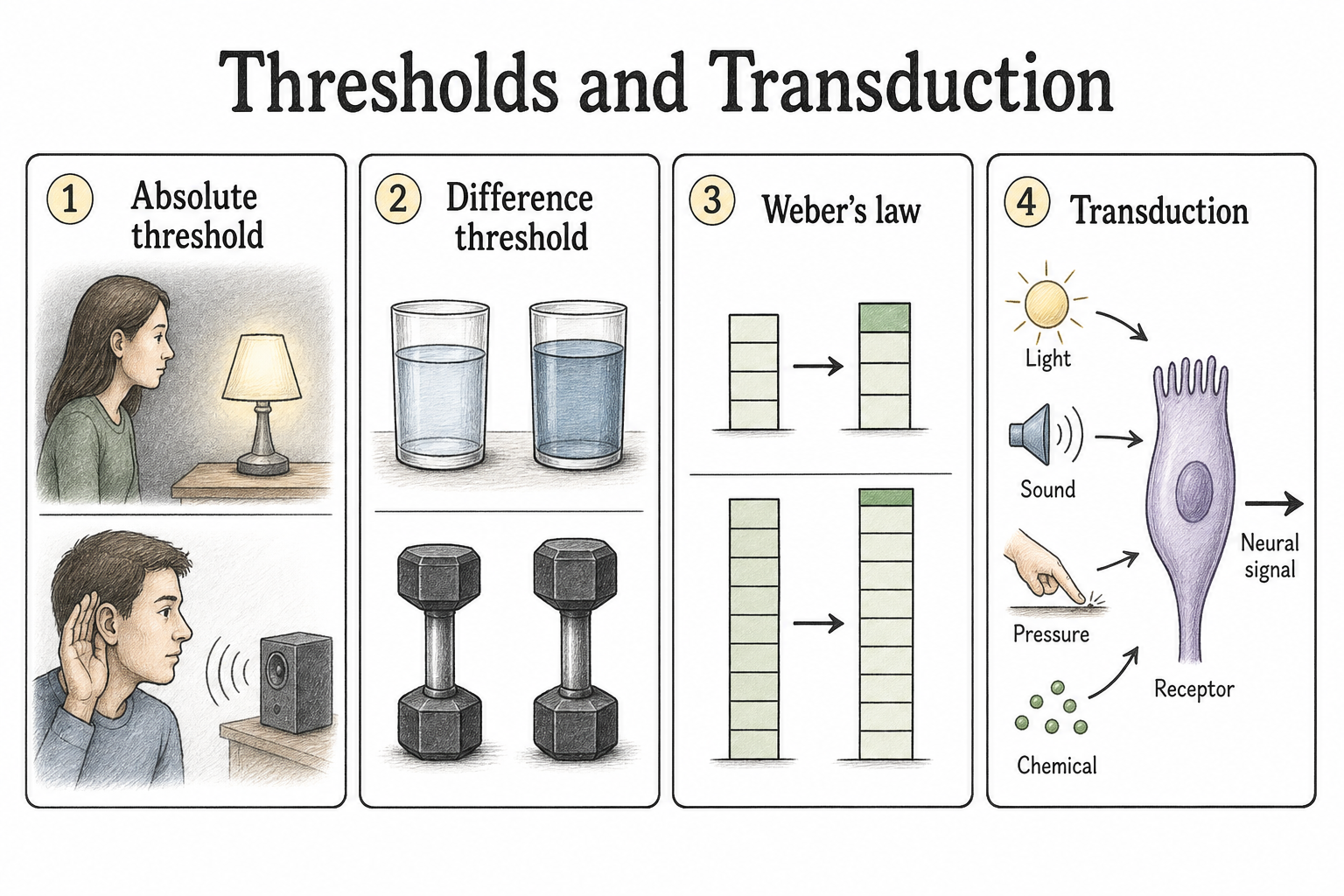
Sensation is detecting physical energy or chemical information from the environment and body. Transduction converts that information into neural signals.
The AP exam often asks which sensory system is being used, what threshold concept applies, or how sensory information reaches the brain before perception interprets it.
Thresholds and Transduction
| Concept | Meaning | AP Clue |
|---|---|---|
| Absolute threshold | Minimum stimulation needed to detect a stimulus half the time. | Barely hearing, seeing, tasting, or feeling something. |
| Difference threshold / JND | Minimum change needed to detect a difference. | Noticing that volume, weight, or brightness changed. |
| Weber's law | Detecting change depends on proportional difference. | Same added amount is easier to notice when the original amount is small. |
| Transduction | Converting sensory input into neural signals. | Light, sound, pressure, or chemicals become nervous-system messages. |
Adaptation, Interaction, and Synesthesia
Sensory adaptation is reduced sensitivity after constant stimulation. It helps the nervous system focus on changing information.
| Concept | Meaning | Example |
|---|---|---|
| Sensory adaptation | Reduced response to unchanging stimulation. | You stop noticing a constant smell. |
| Sensory interaction | One sense influences another. | Smell changes flavor perception. |
| Synesthesia | One sensory experience triggers another sensory experience. | A person experiences colors when hearing sounds. |
Vision System
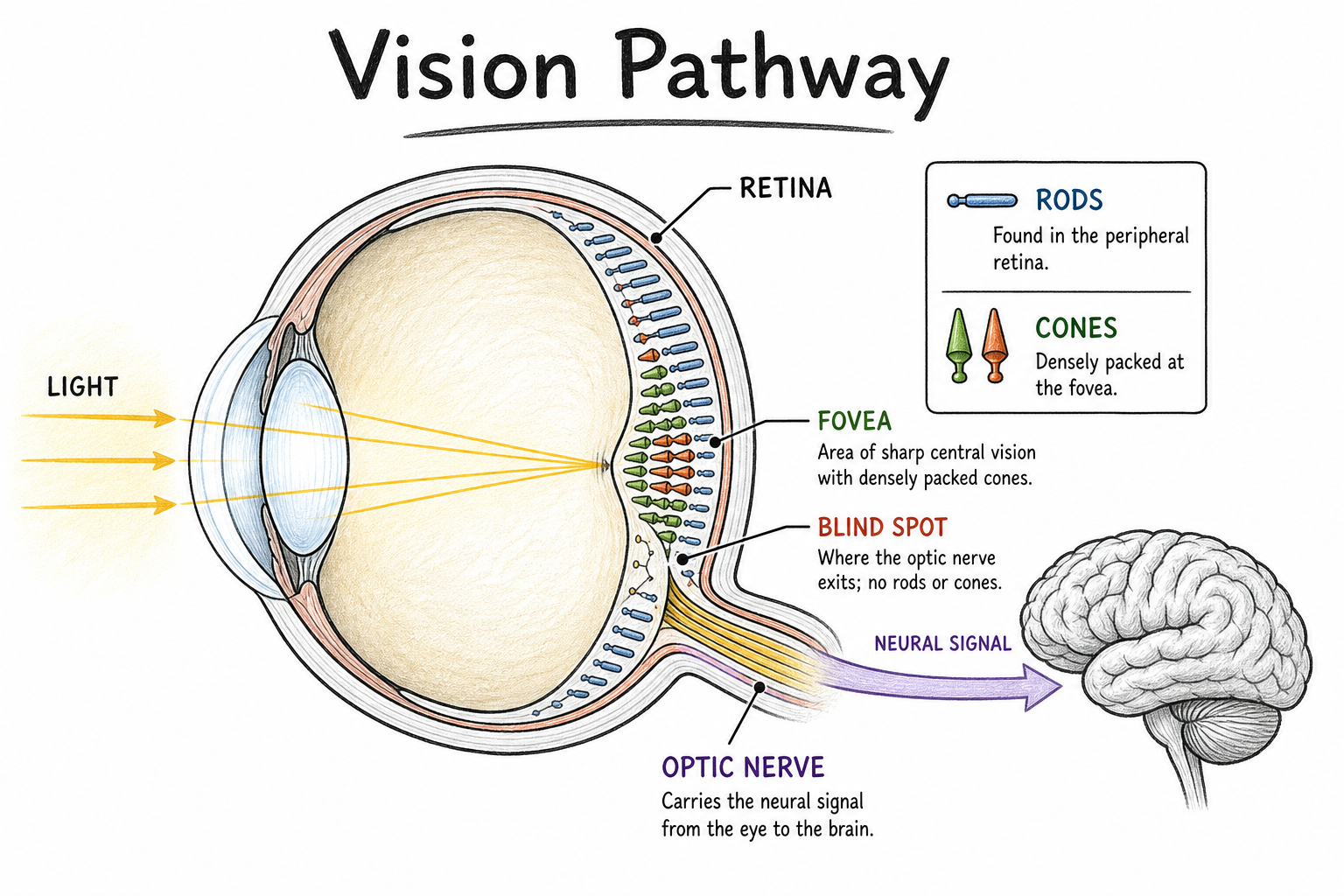
Vision begins with light and ends with neural information that the brain can process.
| Structure or Concept | Function | AP Clue |
|---|---|---|
| Retina | Light-sensitive surface at the back of the eye. | Photoreceptors detect light. |
| Rods | Detect black/white and low light. | Night vision and peripheral sensitivity. |
| Cones | Detect color and fine detail. | Daylight, color, detail. |
| Fovea | Area of sharpest central vision. | Fine detail when looking directly at something. |
| Blind spot | Point where optic nerve leaves the eye and no receptors exist. | Missing receptor area. |
| Optic nerve | Carries visual information to the brain. | Neural pathway from eye. |
Color Vision
Color vision is often tested through theory clues rather than eye anatomy alone.
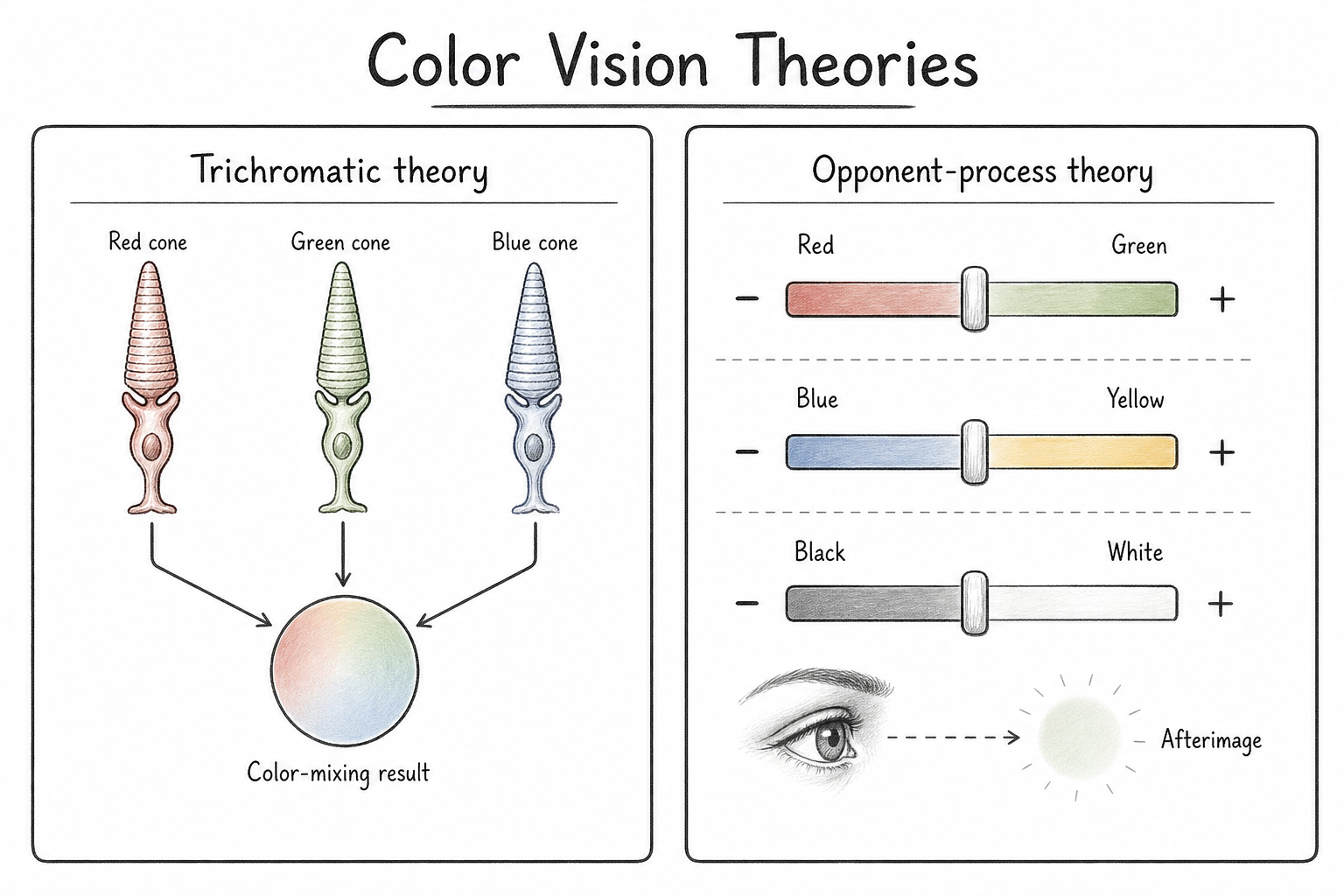
| Theory | Core Claim | AP Clue |
|---|---|---|
| Trichromatic theory | Color vision uses three types of cones. | Red, green, blue cone sensitivity; color blindness patterns. |
| Opponent-process theory | Color is processed in opposing pairs. | Afterimages and red/green, blue/yellow, black/white pairs. |
These theories work at different levels of visual processing, so one does not simply erase the other.
Auditory System
Hearing begins with sound waves and ends with neural signals traveling through the auditory nerve.
| Structure or Concept | Function | AP Clue |
|---|---|---|
| Frequency | Related to pitch. | High or low sound. |
| Amplitude | Related to loudness. | Loud or soft sound. |
| Eardrum | Vibrates from sound waves. | Sound energy begins mechanical movement. |
| Middle ear bones | Transmit vibrations. | Hammer, anvil, stirrup style pathway. |
| Cochlea | Fluid-filled structure containing hair cells. | Transduction for hearing. |
| Auditory nerve | Carries hearing information to brain. | Neural hearing pathway. |
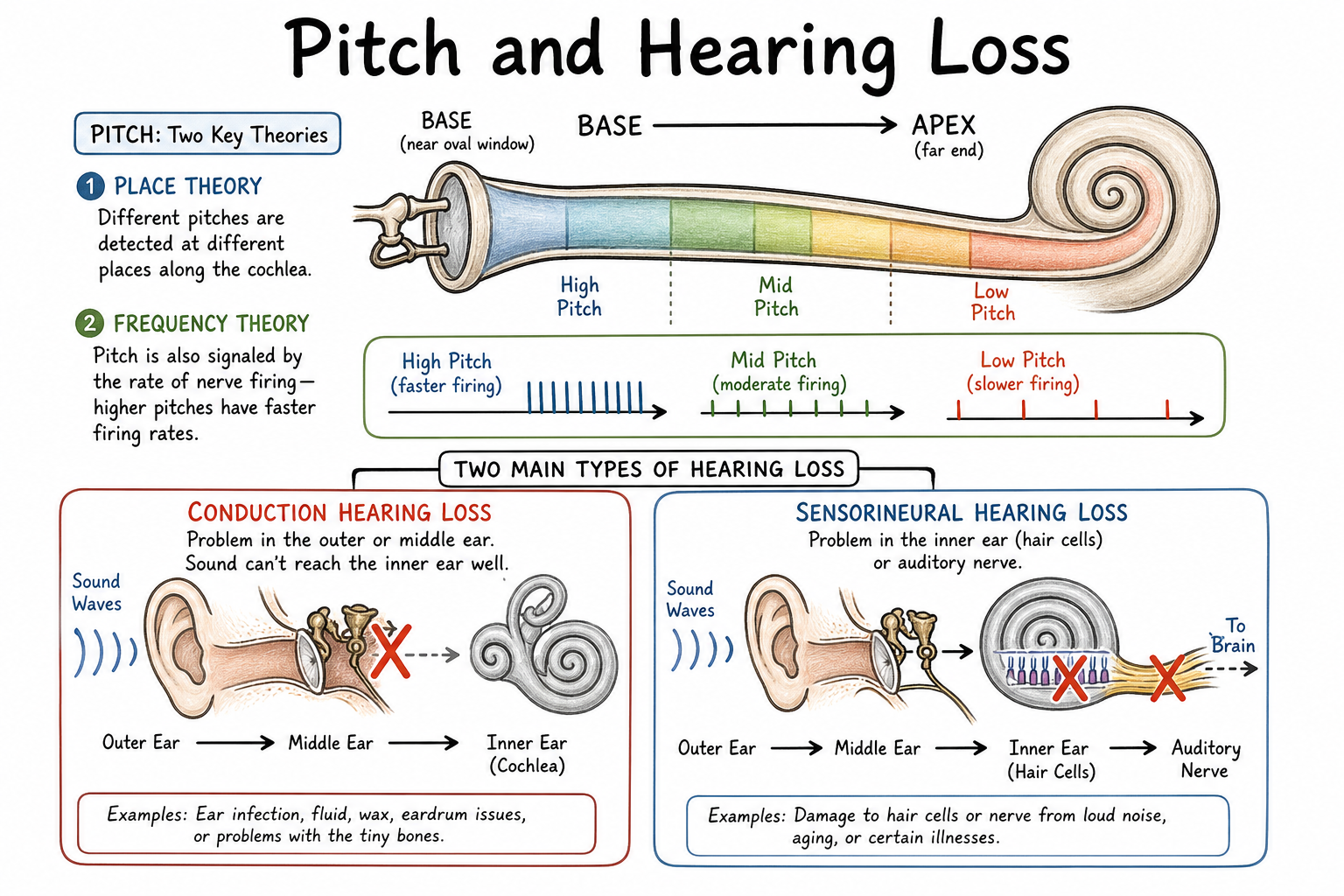
Pitch and Hearing Loss
| Concept | Meaning | AP Clue |
|---|---|---|
| Place theory | Pitch is coded by where the cochlea is stimulated. | High-pitched sounds and specific cochlear locations. |
| Frequency theory | Pitch is coded by neural firing frequency. | Lower pitches and firing rate clues. |
| Conduction hearing loss | Problem conducting sound through outer or middle ear. | Mechanical pathway issue. |
| Sensorineural hearing loss | Damage to hair cells or auditory nerve. | Nerve or receptor damage. |
Chemical Senses
Taste and smell detect chemical information. They often interact, which is why flavor changes when smell is blocked.
| Sense | Detects | AP Clue |
|---|---|---|
| Gustation | Taste chemicals. | Sweet, salty, sour, bitter, umami. |
| Olfaction | Airborne odor chemicals. | Smell, odor, flavor influence. |
| Sensory interaction | One sense changes another. | Food tastes bland when the nose is blocked. |
Touch, Pain, Vestibular, and Kinesthetic
| System | What It Tracks | AP Clue |
|---|---|---|
| Touch | Pressure, warmth, cold, and related skin input. | Skin receptors. |
| Pain | Potential or actual tissue damage. | Warning signal and pain control. |
| Gate-control theory | Spinal cord "gates" can influence pain signals. | Rubbing an injury reduces pain sensation. |
| Vestibular sense | Balance and head movement. | Inner ear, dizziness, equilibrium. |
| Kinesthetic sense | Body position and movement. | Knowing limb position without looking. |
AP Scenario Decoder
| If the Prompt Mentions... | Think... | Why |
|---|---|---|
| Minimum detectable stimulation. | Absolute threshold. | Detection at the edge of awareness. |
| Minimum detectable change. | Difference threshold / JND. | Noticing a difference. |
| Constant odor fades. | Sensory adaptation. | Response decreases to unchanging input. |
| Light becomes neural signal. | Transduction. | Physical energy becomes neural message. |
| Afterimage. | Opponent-process theory. | Color pairs are involved. |
| Balance or dizziness. | Vestibular sense. | Inner-ear balance system. |
| Knowing arm position with eyes closed. | Kinesthetic sense. | Body position tracking. |
Vocabulary
- Sensation: Detecting sensory input.
- Transduction: Converting sensory input into neural signals.
- Absolute threshold: Minimum stimulation needed for detection half the time.
- Difference threshold: Minimum difference needed to detect change.
- Weber's law: Difference detection depends on proportional change.
- Sensory adaptation: Reduced sensitivity to constant stimulation.
- Rods: Low-light and black-white visual receptors.
- Cones: Color and detail visual receptors.
- Fovea: Sharpest central vision.
- Cochlea: Inner-ear structure for auditory transduction.
- Gustation: Taste.
- Olfaction: Smell.
- Vestibular sense: Balance and head movement.
- Kinesthetic sense: Body position and movement.
Common Traps
- Sensation/perception trap: Sensation detects; perception interprets.
- Threshold trap: Absolute threshold is detection; difference threshold is noticing change.
- Adaptation trap: Adaptation is reduced sensitivity to constant input, not damage.
- Vision trap: Rods help low-light vision; cones help color and detail.
- Hearing trap: Frequency relates to pitch; amplitude relates to loudness.
- Vestibular/kinesthetic trap: Vestibular is balance/head movement; kinesthetic is body position.
Quick Check
You are ready when you can explain transduction, sort threshold concepts, and match vision, hearing, chemical, touch, pain, vestibular, and kinesthetic clues to the right sensory system.